
Open top containers can take security of tall or oversized cargo that cannot be fitted into the ordinary dry boxes, and they both have some serious structural variance but the results of the structural difference between them come up as very different in terms of safety, cost, and functionality. Most project cargo crews fail on the assumption of a flat rack because no roof translates to an unlimited height. Practically, however, sidewall containment, weight distribution and exposure hazard often render an open top the wiser -and safer -choice of certain tall loads.
The choice between open top and a flat rack is not dependent on height, but rather on the size and weight distribution, stability issues, and exposure to the environment. Hurrying to make this decision without the necessary analysis will result in damages to the cargo, increased insurance payments, delays in ports or even denied reservations.
The introduction of open top container transport solution to support the needs of the structural support and the profile of the cargo is to start with the selection of the correct open top container that will assist in effective decision making. Now, let us dissect the major factors.
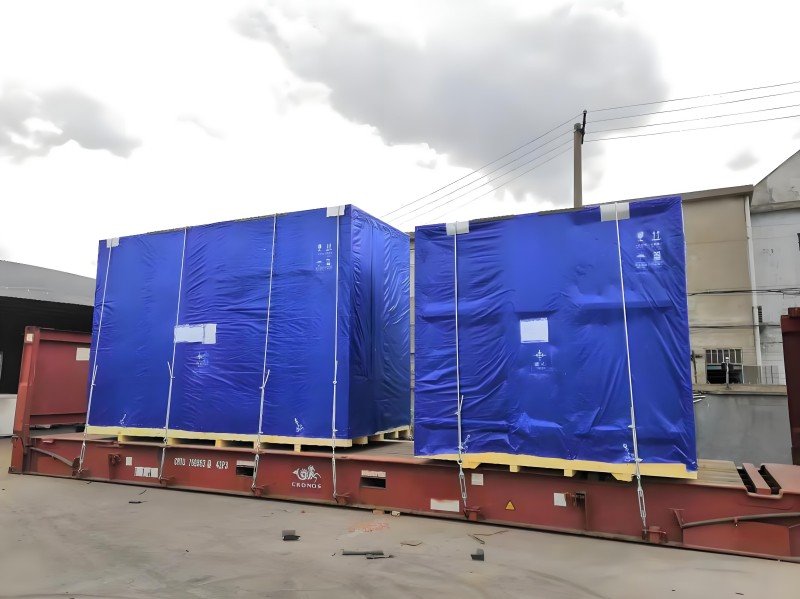
Structural Differences Between Open Top and Flat Rack
Their main difference is in the concept of containment: the open tops have both complete sidewalls to support construction of lateral forces and the flat racks do not have that feature at all and are arranged to provide the maximum access to the side.
A container with an open top keeps the regular sidewalls (common inside height usually between 2.35 and 2.39 m (internal)) but eliminates the fixed top- most of it replaced by removable bows and tarpaulin. This provides fair weather coverage and good side AR. Flat racks, on the other hand, have no side, no roof, only a reinforced floor and collapsible or fixed end walls, and must depend entirely on external lashing to maintain any sort of stability.
Here’s a quick comparison:
| Feature | Open Top Container | Flat Rack |
| Roof | Removable (bows + tarpaulin) | No roof |
| Sidewalls | Present (full height) | None |
| Lateral stability | Higher (built-in side support) | Lower (requires extensive lashing) |
| Exposure to weather | Moderate (tarpaulin cover possible) | High (fully exposed) |
| Suitable for over-width cargo | Limited (width must stay within ~2.35 m internal) | Yes (cargo can overhang sides) |
This structural gap has a direct effect of stability and protection- most particularly of tall cargo of any width or uneven weight.
Why Sidewalls Matter More Than Most Realize
Sidewalls are not ordinary walls – they support the load of a vessel way in a kind of natural bracing like that which in the event of ship rolling, or in road transportation, takes up as a counterpart the lateral forces. Flat racks require specific lashing schemes (which have to be approved by naval architects), and are difficult to perform exactly without high risk of failure.
Dimensional Considerations for Tall Cargo
Height of cargo above the top rail is not the only component in the equation- width and overhang usually determine what type the container will be.
Measure this by using the following checklist:
| Dimension | Open Top Suitable? | Flat Rack Suitable? | Notes |
| Over-height only | Yes | Yes | Both allow top protrusion |
| Over-width | No | Yes | Flat rack allows side overhang |
| Over-length | Limited | Yes | Flat rack better for extreme length |
| Within width limits | Preferred | Optional | Open top leverages side support |
The determining element is often width. When the cargo remains in the internal width (even at its protruding end) of the container at the internal width of the container of 2.35 m, then open top is normally the most stable. A flat rack is required at this point when it sticks out past the side rails, regardless of increased securing.
OOG Classification Impact
Carriers count them together as OOG when they are larger than normal dimensions yet flat racks usually create more route controls and higher surcharges since they are more exposed.
Weight Distribution and Stability
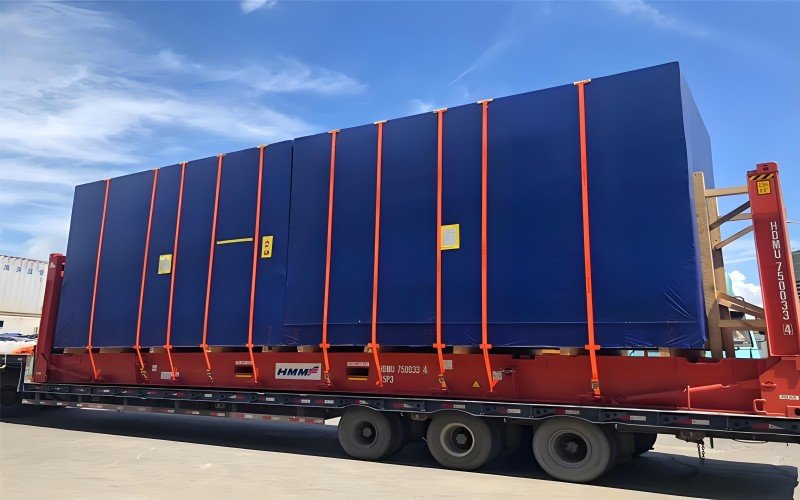
Open tops have integrated side restraint so that they are much more tolerant to tall cargo with high center of gravity.
Flat racks will solely be based on lashing; that is; chains, straps and turnbuckles are to be taken to the correct tension to avoid movement. An overstretched load or loose lashing may lead to disastrous motion on the ocean.
| Stability Factor | Open Top | Flat Rack |
| Side restraint | Built-in | None (lashing only) |
| Lashing dependency | Moderate | High |
| Suitable for compact heavy cargo | Yes | Yes |
| Suitable for wide unstable cargo | Limited | Better (if lashed correctly) |
At flat racks, high center-of-gravity risks are exaggerated; we have witnessed scenarios where tall and narrow loads fell over due to a port maneuver because the lashings became loose. The reduction of this by open tops is by friction and containment along the sidewalls.
Weather Exposure and Cargo Protection
In flat racks, cargo is completely exposed to the wind, rain, salt spray and UV- huge dangers to the delicate equipment such as electrical transformers, coated steel or electronics.
The open tops support tarpaulin covering (usually with wooden dunnage or air bags underneath) which cuts down weather damage by a big margin. In the case of tall cargo that is corrosion sensitive or at risk in other ways of the weather, this protection can easily have a greater value than the perceived height benefit of flat racks.
Open tops will generally reduce long-term risk and insurance premiums when it is essential to protect the environment (e.g. export transformers or painted machinery).
Cost Comparison Factors
Base ocean freight might appear the same, but total landed cost differences radically change.
| Cost Element | Open Top | Flat Rack |
| Base freight | Slightly higher | Variable |
| OOG surcharge | Height-based | Width & height-based (often higher) |
| Securing material cost | Moderate | Higher (more lashing needed) |
| Weather protection cost | Moderate (tarpaulin) | Higher (extra wrapping) |
| Crane handling charges | Standard (top lift) | Potentially higher |
Flat racks often demand additional securing fabric and special lashing oversight and drive the overall cost up, particularly with the addition of weather wrapping.
Operational and Approval Considerations
Flat rack bookings are challenged more strictly by the carriers because of the stability issues and the effect of vessel slots. Port terminals can put a limit on the crane capacity or special handling cost on wide/overhanging load. The open tops can easily fit in the common container stacks, rapidly expediting approvals.
It is important to always send comprehensive drawings and weight distribution schemes early, flat racks may not be accepted at all in case the stability is not possible.
Common Decision Mistakes
Most of the teams select a flat rack because it has height clearance and failure to consider these pitfalls:
- No roof means that it is the best choice, automatically.
- Undervaluing the lateral stability requirements (with the shift risks)
- Foresight disregards complexity security and additional labor expenses.
- Failure to consider exposure to weather on sensitive objects.
- Comparison of base freight (omitted total cost blowouts) only.
Such consequences are cargo shift/damage, rejected insurance claims, port delays, re-stuffing charges, or in the worst models, total loss.
Conclusion — Container Selection Is an Engineering Decision
An open top container or a flat rack of tall cargo is a case that demands a systematic dimensional analysis, stability analysis, and cost analysis. The correct choice considers height clearance, side support, exposure to the weather and securing demands to provide safe and efficient O libraries transportation.
Address it like an engineering option: take meticulous measurements, calculate stability, consider environmental risks, and work out overall logistics cost– not the most evident height fit. When it is done well, it saves headaches and ensures that the cargo and the budget are safeguarded.