
Oversized cargo and project cargo are concepts in logistics that are alike but very different in the context of international freight and project logistics; oversized cargo is freight larger than the standard container sizes, whereas the project cargo is the transportation of a number of large or complicated cargo pieces related to a particular project.
To be clear in the very beginning: Oversized cargo is a type of individual cargo that is beyond the usual size or weight threshold and that needs the use of special containers or equipment. Project cargo in its turn can be defined as the coordinated delivery of numerous large, heavy, or complex cargo units in relation to a particular project in the industrial or infrastructure field.
These terms are used interchangeably by many people, but they are used in professional logistics to depict various elements in transporting freight. Oversized cargo is used to refer to the physical dimensions or weight of the freight and project cargo is used to refer to the complexity and coordination of the logistics needed to move several large pieces to complete a particular project. This distinction can be important to the logistics managers and project planners to ensure that they are not classified in a wrong manner that may cause inefficiencies in transport planning and higher costs.
This distinction is essential as it has a direct effect on the shipment management process, starting with the route selection and equipment requirements. As an example, a large box may just need a minor alteration in shipping container, but a project shipment may be several months of organization involving several types of transportation. We will divide each concept in the further sections and compare them and address the implications of the concept in overweight cargo shipping and project cargo logistics.
What Is Oversized Cargo in Shipping?
The basic definition of over-sized cargo is based on the fact that the cargo is physically large or heavy and cannot fit into the typical shipping occupancies.
The shipping meaning of this is any cargo that exceeds the standard dimensions of a 20-foot or a 40-foot container, which are made to stack regular cargos. These dimensions are width (typically 8 feet), height (8.5 feet) length (19.4 or 39.5 feet) and weight (approximately 44,000 pounds per container). Beyond these, cargo requires different handling in order to be transported safely and in compliance with the law.
To illustrate the key traits:
| Oversized Cargo Characteristic | Description |
| Excess width | Cargo wider than container limits, often requiring side-loading or specialized frames |
| Excess height | Cargo taller than container roof, potentially needing open-top solutions |
| Excess length | Cargo longer than container dimensions, such as extended beams or pipes |
| Excess weight | Cargo exceeding container payload limits, risking structural failure if not managed |
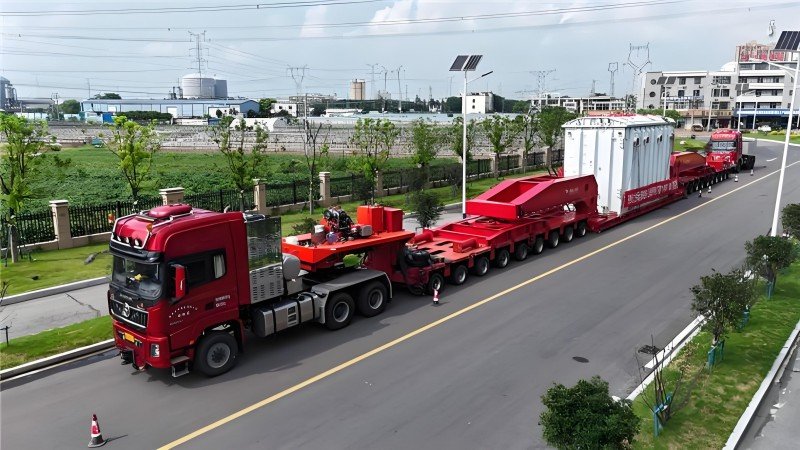
Some of the examples of oversized cargo include excavators, industrial machinery, huge generators, transformers and steel structures. Such products are used in the construction and manufacturing sector where machinery has to be transported in a whole intact condition without the need to dismantle it.
The transport of this freight is usually conducted with the help of special logistics, such as flat rack or open-top containers, which can be safely lashed and kept out of the weather. Very large pieces could also be shipped by breakbulk techniques or roll on roll off (RoRo) vessels.Businesses regularly depend on the help of professional services on the transportation of oversized cargo to ensure the safety of large-scale equipment that cannot be placed into regular containers and does not violate international norms, such as the International Maritime Organization (IMO) standards. Our oversized cargo transportation services are specifically designed to handle these requirements with proven expertise and equipment.Here, emphasis is placed on the inherent qualities of the cargo but not on the larger picture of its usage and thus oversized freight haulage is an issue of physical adaptation.
What Is Project Cargo?
Project cargo is defined by its connection with a particular large-scale project, a coordinated flow of many large or complicated objects.
In contrast to separate shipments, project cargo is attached to industrial or infrastructure projects, in which time and connection are essential. This may include preliminary survey of the sites, to final assembly, and shipments may occur over a long duration.
Key features include:
| Project Cargo Feature | Description |
| Multiple cargo units | Often hundreds of items, from components to full assemblies |
| Complex logistics | Multi-stage transport planning across sea, land, and air |
| Project-based | Linked to construction or infrastructure projects, with milestones dictating delivery |
| Long-term coordination | Shipments scheduled over months, requiring ongoing adjustments |
Incidents of typical projects include wind farm construction (blades, towers and nacelles), oil/gas infrastructure (pipelines and platforms), installation of power plants (turbines and boilers) and mining equipment projects (drills and conveyors). These need careful planning to fit within the project schedules and usually involve several stakeholders such as the engineers and the contractors.Fundamentally, project cargo logistics focuses on the coordination of various components, such that all the components are brought in time to enable a smooth integration in the field. Bentlee’s engineering logistics solutions excel at managing these multi-phase, high-stakes industrial projects from start to finish.
Key Differences Between Oversized Cargo and Project Cargo
The main contrasts between oversized cargo and project cargo are in their areas of operation, starting with simple physical objects and ending with the elaborate logistical coordination.
Whereas oversized cargo focuses on the issue of the size or weight of one item, project cargo is a larger-scale business of managing a whole shipment ecosystem towards a specific purpose. This gives rise to different degrees of complexity of planning and execution.
For a clear comparison:
| Factor | Oversized Cargo | Project Cargo |
| Definition | Cargo exceeding standard dimensions | Coordinated transport of project components |
| Cargo quantity | Usually single large item | Multiple cargo pieces |
| Logistics complexity | Moderate | Very high |
| Transport planning | Focus on single cargo movement | Multi-stage project coordination |
| Typical industries | Construction, machinery | Energy, infrastructure, oil & gas |
It is interesting to mention that oversized cargo is frequently part of the shipment under project cargo, but the conditions differ. Choosing an experienced OOG logistics partner helps ensure the right classification and planning approach from the very beginning.As an illustration, one large transformer can be oversized cargo when shipped on its own but is project cargo when it is shipped with other parts to construct a power plant. This overlap is the reason behind why the distinction between oversized cargo and project cargo is often misunderstood though the awareness of this distinction can be used to adjust logistics plans appropriately.
Typical Transport Methods for Oversized and Project Cargo
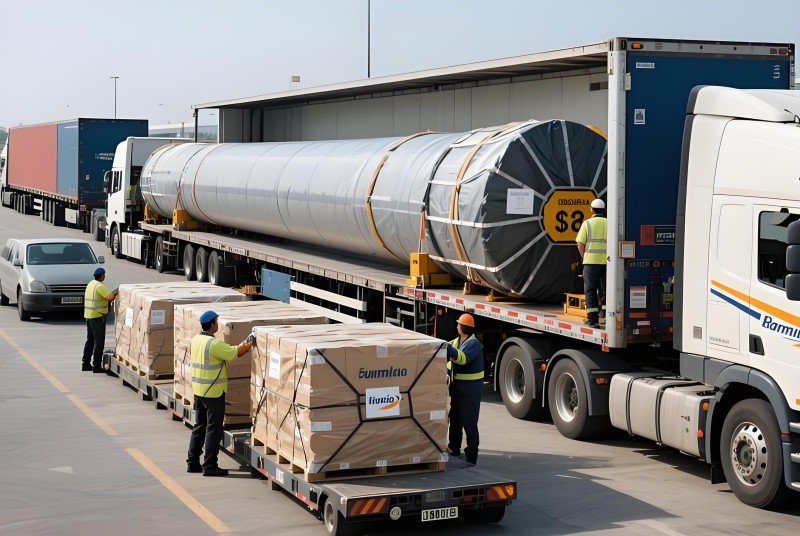
Both project cargo and oversized cargo require special means of transportation, and the decision depends on the size of the shipment and the needs.
The process of selection begins with evaluating the details of cargo, and then comparing it to the modes available that are safe and efficient.
Here’s a breakdown:
| Transport Method | Oversized Cargo Use | Project Cargo Use |
| Flat rack containers | Common for securing irregular shapes | Sometimes, for individual large components |
| Open top containers | Common for tall items | Sometimes, integrated into phased shipments |
| Breakbulk vessels | Used for extreme cargo that can’t containerize | Frequently used for bulk project loads |
| Heavy haul trailers | Used for inland transport of heavy items | Used for multiple deliveries to project sites |
Where oversized cargo shipping is required, it is usually focused on container modifications to cope with one-time issues. Our flat rack container shipping solutions provide the stability and lashing expertise needed for wide and irregular loads. Meanwhile, project cargo vs oversized cargo logistics can be a combination, e.g., ocean breakbulk, and subsequent overland heavy haul, and the routes are calculated to produce the minimal disruptions. For tall cargoes, open top container shipping offers flexible top-loading options integrated into larger project plans.Such issues as port capacity and road permits also play an important role, which is why it is important to have some experienced management.
Industries That Frequently Use Oversized and Project Cargo Logistics
The issue of over-sized freight transport and project cargo is a frequent phenomenon experienced by certain industries because of the specifics of their work.
These industries are associated with equipment and materials which are of large scale nature and require special handling.
Common examples:
| Industry | Typical Cargo |
| Construction | Excavators, cranes |
| Renewable energy | Wind turbine blades |
| Oil & gas | Drilling equipment |
| Power generation | Transformers |
| Infrastructure | Steel bridge components |
In these areas, providers of logistics that have experience on projects cargo are needed because they are familiar with the relationship between project need and the type of cargo. As an example, the renewable energy projects are characterized by the combination of oversized components such as blades with synchronized logistics of tower parts, which must be timely so as not to delay.
Logistics Planning Differences Between the Two
The planning of the oversized cargo and project cargo are vastly different in concentration, time and risk evaluation.
Project cargo requires a systemic approach of the whole operation, unlike oversized cargo planning which focuses on immediate solutions of handling.
Key aspects:
| Logistics Aspect | Oversized Cargo | Project Cargo |
| Planning focus | Single shipment | Multi-shipment coordination |
| Timeline | Short-term planning | Long-term project schedule |
| Documentation | Standard freight documents | Complex project documentation |
| Risk management | Cargo stability | Project schedule and coordination |
Cargo work on projects can also necessitate specific logistics teams due to the interdependency of the components, wherein delays in a project can stall a project. This is unlike with oversized cargo where the risks are limited to the transportation of the item. Both instances require effective planning which includes site surveys and regulatory compliance but the magnitude of project cargo increases the necessity of contingencies.
Common Misunderstandings in Cargo Classification
The misunderstanding of the oversized cargo and the project cargo may result in less than optimal logistics results and this is due to the unseen details in the terminologies.
- When the cargo is assumed to be oversized, it is perceived to be project cargo: It is said that any large object is project cargo, where in fact, it is usually a separate shipment with no project connection.
- Ignorance of logistics complexity in planning large shipments: Larger shipments may seem easy, but being a part of a larger project, they need cargo project strategies.
- Underappreciation of the coordination need of project cargo: Planners tend to consider size in isolation, not considering the requirement of staged deliveries and multi-modal organization.
- Applying the wrong transport solutions: Applying the wrong transport methods to project cargo may lead to inefficiencies such as wrong scheduling.
By explaining these, it is better to plan the logistics and cost-control and fit these strategies to the real nature of the shipment, be it a mere oversized freight movement, or a positional project cargo logistics project.
Conclusion — Understanding the Difference Improves Logistics Planning
Overall, oversized cargo is concerned with the physical size of freight whereas project cargo is concerned with the coordination and the complexity of the logistics involved when transporting various large parts of industrial projects in large quantities. Such differentiation allows the logistics managers to use the right approach, including the types of containers and scheduling and ultimately to make efficiency and minimize the risks in the international shipments. Understanding these concepts, the teams will be better placed to deal with the complexities of global freight resulting in more predictable results in their work. Contact Bentlee today to get a project cargo or oversized shipping quote and benefit from tailored, professional logistics planning.