
The international maritime organization (IMO) provides the international standards of maritime safety in various forms such as conventions and codes such as SOLAS and CSS Code (Code of safe Practice of cargo stowage and securing). In the case of open top OOG (Out-of-Gauge) cargo, when cargo is shipped in a container with removable or missing roofs in order to fit some over-height or oversized cargo, there are special safety concerns in these standards. Open top designs expose the cargo to direct environmental forces and therefore effective securing, declaration and vessel integration becomes even more important in terms of ensuring stability, crew protection as well as marine pollution.
The general mistake shippers make when it comes to compliance with OOG concerns is that it is only a case of announcing that the ship will have oversized dimensions. Practically, IMO compliance of open top OOG cargo goes well beyond measurements: it requires engineered cargo securing to dynamic sea forces, accurate documentation, specific stability trials of the vessel, and, in the event of hazardous materials, a complete compliance with the IMDG Code.
Open top OOG shipping that is allowed by IMO commences with the accurate dimensional measurements, structural examination, and carrier evaluation before confirmation of a booking.
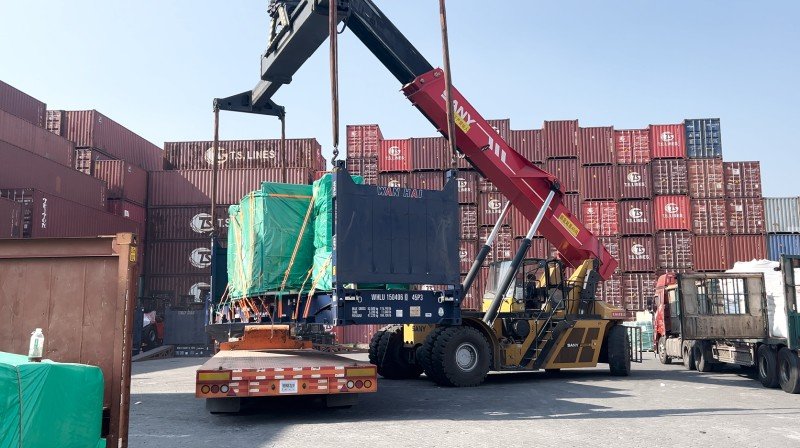
What Does IMO Compliance Mean for Open Top OOG Cargo?
IMO open top OOG compliance is a compulsory regulatory framework, which guarantees safety transportation since open top loads are susceptible to risks specific to oversized and exposed freight on ships.
The IMO system, the main regulator of cargo stowage and securing is the Chapter VI of SOLAS and the CSS Code that is applied globally. With open top shipments, this interrelates well with IMDG Code (International Maritime Dangerous Goods Code), which is a constituent rule of IMO in case of hazardous substances. Although not every OOG cargo is hazardous, all cargo that is classified under IMDG requires two compliance.
Applicability encompasses oversized, over-height and in the event of utility, hazardous OOG loads. The major areas of focus are the stability of the vessels (list and trim problems related to high or projecting cargo) and the distribution of loads to eliminate undue strains and loads on container fittings or the deck structures.
| Regulatory Area | Requirement |
| Cargo Declaration | Accurate OOG dimensions and weight |
| Securing | Compliant lashing standards per CSS Code |
| Dangerous Goods | IMDG Code adherence if applicable |
| Vessel Stability | Load planning review by carrier |
All these factors serve to protect against cargo shift that has the potential to destroy the whole journey.
Dimensional Declaration and OOG Classification
Correct dimensional declaration is the basis of IMO compliance of open top OOG cargo- any mismatch will lead to rejection at the loading point.
Open top containers will allow the cargo to stick out of the roof rails, though that will require shippers to give precise measurements of the height above the rails, side/overhang projections and center of gravity (COG). The weight has to be checked because it has a direct impact on the securing requirements and the calculation of vessel stability.
- Height over rail + Assesses OOG clearance and possible deck slot limitations.
- Width projection Projection Area of vessel slots and surrounding container compatibility.
- Weight confirmation → Confirms the structural security of container and binding points.
- COG (Center of Gravity) → Essential in stability examination in the roll and pitch.
- Sketches of cargo- accurate- → Must be reviewed by the carriers, displaying lashing-points and projections.
Such wrong or inefficient statements often result in the rejection of cargo, since the carriers cannot ensure its safe stowage till they have complete data.
Cargo Securing Under IMO Guidelines
Open top OOG cargo securing per IMO requirements should be resistant to the dynamic forces caused by sea conditions set of certified equipment and designed layouts.
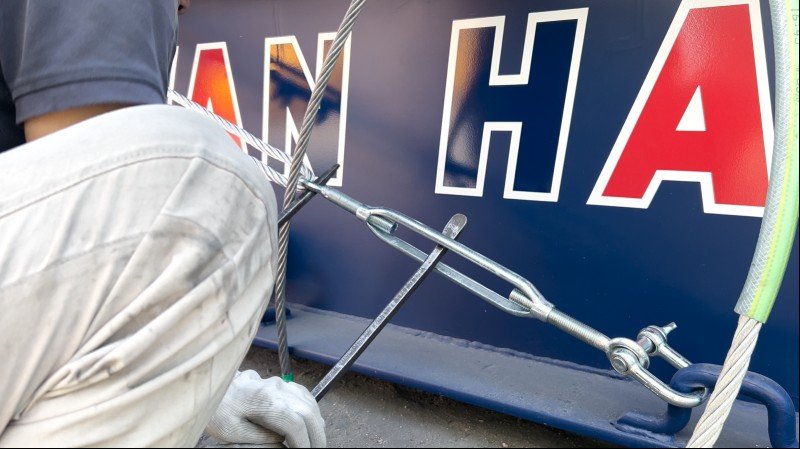
The CSS Code provides the principles of the calculation of forces (transverse, longitudinal, vertical) and demands lashing to overcome sliding, tipping, and racking. In open top loads, securing can be chain lashers or wire ropes or turnbuckles to the castings of corners of the containers or deck fittings, with angles ideal (usually a 25 deg angle or less to provide effective restraint).
- Chain lashing → Provides high tensile strength for heavy loads.
- Cross-lashing → Provides resistance to rolling motions in the lateral direction.
- Timber blocking -Transfers load and eliminates point pressure.
- Tension checking – -Assures that there is no slack in transit.
Any arrangement made should take into consideration worst-case sea states, and pre-loading inspections must be obligatory so as to ensure integrity.
Dangerous Goods and IMDG Integration
In case the open top OOG cargo contains hazardous substances IMDG Code requirements are incorporated in the entire IMO compliance.
Under SOLAS Chapter VII, using the IMDG Code, which is mandatory, substances are grouped based on UN number, packing groups, and packaging, labeling, and segregation. In the case of OOG shipments, it would entail more scrutiny: hazardous products may require special separation with other incompatible products, despite open configurations, which may greatly increase the exposure risk.
The shipment should be accompanied by a Dangerous Goods Declaration (DGD) with appropriate shipping name, class and the packing instructions. The rules of segregation do not allow reactions (e.g. the presence of the acids and bases), and the necessity of such open top may lead to additional protective behaviors, like weatherproof cover.
IMDG is not independent: it is a part of IMO structure in order to assure that hazardous OOG does not create a threat to the safety of vessels or marine environments.
Vessel and Carrier Approval Procedures
Prior OOG transport approval of vessels and carriers needs to be submitted and their feasibility checked by an expert.
Some specific prior knowledge is required by the carriers, such as dimensions, weight, sketches and securing plans, usually weeks ahead. Slot planning takes the over-height effects of stack weights and visibility. Stability calculations determine the GM (metacentric height) of a vessel when loaded.
- Carrier checkup → Costs capacity of vessels and routing appropriateness.
- Terminal approval- verifies equipment handling and safety procedures.
- Stability examination → Prevents the imbalance of high or asymmetric loads.
- Insurance check-up and balance Except- Excepts Verify mutual coverage of liability
These measures reduce the element of surprise on loading.
Environmental and Safety Obligations
The IMO rules have environmental and safety requirements that are more geared towards preventing cargo shift, water ingress damage and leakage of hazardous cargo in unrestricted top OOG shipments.
Open arrangements increase the risk of exposure of water or injury to the crew during tie. Tarpaulins or protecting sheet must keep off ingress, and shifts should be removed by securing. In the case of hazardous OOG, the environment is not released.
Failure to comply raises the danger to crew (e.g. falling lashings), vessel integrity and marine flora and fauna- perhaps resulting in pollution incidents as regulated by MARPOL.
Common IMO Compliance Mistakes
The open top OOG shipping is prone to common IMO compliance errors through failure to sufficiently estimate the depth of the regulations, with the consequences being dire, both operational and financial.
- Underreporting OOG dimensions – results in inappropriate slot allocation and rejection.
- Poor securing – Does not hold back sea forces, may shift, and be lost.
- Lack of records → Slows down approvals and attracts fines.
- Wrong DG classification → The violation of IMDG, leading to the breach of segregation.
- Neglected vessel load plan – Threatens to stability and predisposes to detention.
Some of the consequences are shipment rejection, detentions of vessels at ports, penalties by authorities, insurance claims loss, and the increased liability in processing accidents.
Conclusion — Compliance Is a Structural Obligation, Not a Formality
IMO open top OOG compliance is a structural requirement of the sea that is aimed at safeguarding the stability of the vessels, the safety of the crewmembers and the environmental standard. Correct reporting of dimensions and weight, designed securing arrangements based on the principles of CSS Code and strict documentation, particularly when IMDG is involved, are not part of the decorum, but important elements of responsible maritime transport. By following these standards, the risks that could otherwise pose a threat to lives, vessels, and the marine environment in foreign expeditions are alleviated.