
The purchase of steel structures in open top containers leads to export should include systematic dimensional planning, load stabilization engineering and conformant OOG treatment and not just the selection of a container with removable roofing upon it.
The length and rigidity of steel structures (beam, column, truss, or assembled into a frame), often exceed the maximum height of conventional dry containers, or are top-loaded by design. Open top containers are those containers with top access by cranes rendering them to be a good fit in most structural steel exports. Nonetheless, the rigidity of steel does not bring some risks to naught; spaning may cause uneven distribution of masses, focused forces may be applied on the floor of the container, and the sea movement amplifies the loads on unattached fragments.
Numerous people believe that shipment of steel buildings is simple since they are strong and strong. As a matter of fact, long beams, Non-regular frames and concentrated weight points have the potential of creating structural stress, stability hazard and even deformation in case they are not handled effectively.To be able to export steel structures in open top containers, it is important that there is a proper assessment of its dimensions, designed securement, and distribution of loads. Before the shipment of the product, effective steel structure export through open top containers requires dimensional check, lifting practicability, and OOG declaration plan.
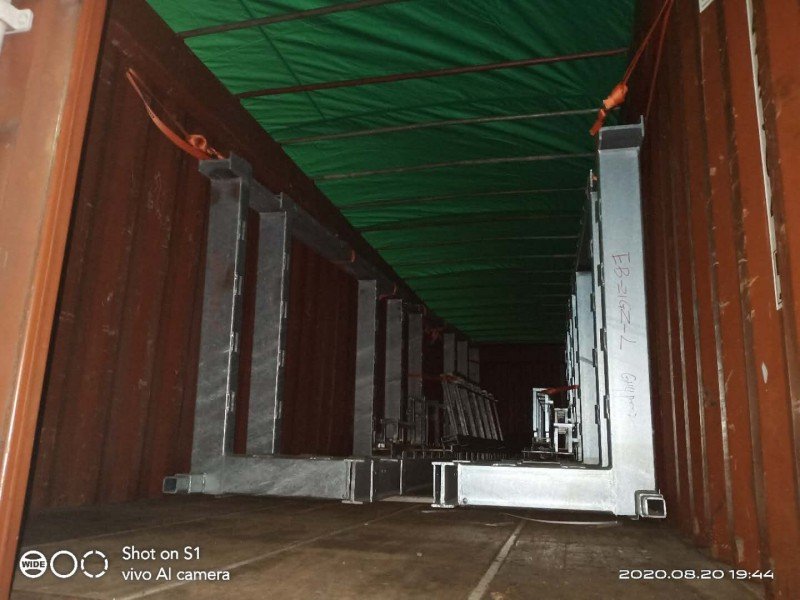
When Is an Open Top Container Suitable for Construction Machinery?
Open top containers are used in steel buildings in cases where cargo is of unusual height above the regular size of container, but falls within the width and manageable OOG limits enabling top-loading and sidewall support.
Available in open top designs, they used to give their side walls the ability to offer a lateral containment in contrast to vertical loading done by the crane which is perfect in over-height beams or columns that cannot pass through regular doors. The best uses are moderate over-height projections over the top rail where tarpaulin coverage may still be made against weather without being overly exposed.
Nonetheless, broad assemblies or excessive lengths tend to pull towards flat racks rather.
Here’s a quick reference:
| Steel Component Type | Open Top Suitable? | Reason |
| Structural beams | Yes (if width fits) | Vertical crane loading; height manageable with moderate OOG projection |
| Steel columns | Yes | Height often fits; rigid nature suits sidewall restraint |
| Wide frame assemblies | No | Width restriction; exceeds sidewall containment |
| Long trusses | Case-by-case | Length evaluation required; potential for excessive overhang or flex |
The open tops are a trade-off between protection and loadability, the preference of a number of steel fabricators who ship beam or in modules.
Dimensional and OOG Classification Planning
Dimensional planning is the key to success i.e. wrong dimensions translate into bookings being rejected or sometimes re-handling and subsequent rejection at the terminal.
With the criteria of being able to gauge the cargo in its transportation setup that any base supports, lifting lugs, or connectors are approximately measured before approaching a carrier. OOG status commences when dimensions go beyond normal internal dimensions (normal width is about 2.35m and normal height is about 2.39m).
Such crucial elements of measurement as are:
- Total height- This is important in the declaration of OOG; It encompasses protruding fittings.
- Total length — Establishes compatibility and overhang risks of containers.
- Weight concentration — It affects the needs in terms of floor loads and reinforcement.
- Width check- In ensures that the sidewalls are given clearance and do not come in contact under any movement.
Also, provide detailed drawings or 3-dimensional models to the carrier. The fact that they have ignored a tiny projection can lead to the rejection and the postponement of the whole project.
Weight Distribution and Structural Reinforcement
Structural Reinforcement and Distribution of weight.
Adequacy in weight distribution will avoid the deformation of the floor and will keep the containers stable- long steel beams will form unequal distribution and will have to be mitigated.
Steel structures have concentrated loads at the ends or connections, which is a potentially dangerous situation as it can cause point loads on the cross members of the container. This may be in excess of allowed floor loads (approximately 4-7 tons/m 2 depending on carrier) without spreading.
Typical risks and the mitigation measures:
| Risk Factor | Consequence | Mitigation |
| Concentrated beam ends | Floor stress or denting | Load distribution plates or timber |
| Asymmetrical placement | Lateral instability | Balanced positioning across length |
| Excess rear weight | Inland axle imbalance | Axle weight check and repositioning |
provide timber dunnage, steel plates, or shoring to bring weight and strong points of container in line. Here, I have noticed that time spent is spent on prevention rather than cure at a later time.
Crane Loading Procedures for Steel Structures
Controlled crane loading will reduce twisting, impact and misalignment- bad practice may ruin the cargo and the container itself.
In long steel pieces, spreader beams should be used to assure clear sling separation and less compressive forces. The ideal angles of slings are 30 deg to 60 deg off horizontal to provide equilibrium between tension and stability, more angled slings is more sling loading whereas lower angled slings may lead to slipping.
Key steps:
- Tie the slings to the certified lifting points or lugs of the steel.
- descent with swing control using tag lines.
- Roll down slowly onto already prepared base supports or dunnage.
- Check contact with container walls or endpoints.
Risks involve twisting of stress of beams, impact on sidewall when sway is taking place, and lack of alignment with the floor beams. Give a duly qualified rigger with experience and knowledge of the flex of steel under the work load.
Securing and Lashing Steel Components
Strong holds power over marine ships- long steel reinforcements enhance acceleration moments forward/aft/laterally.
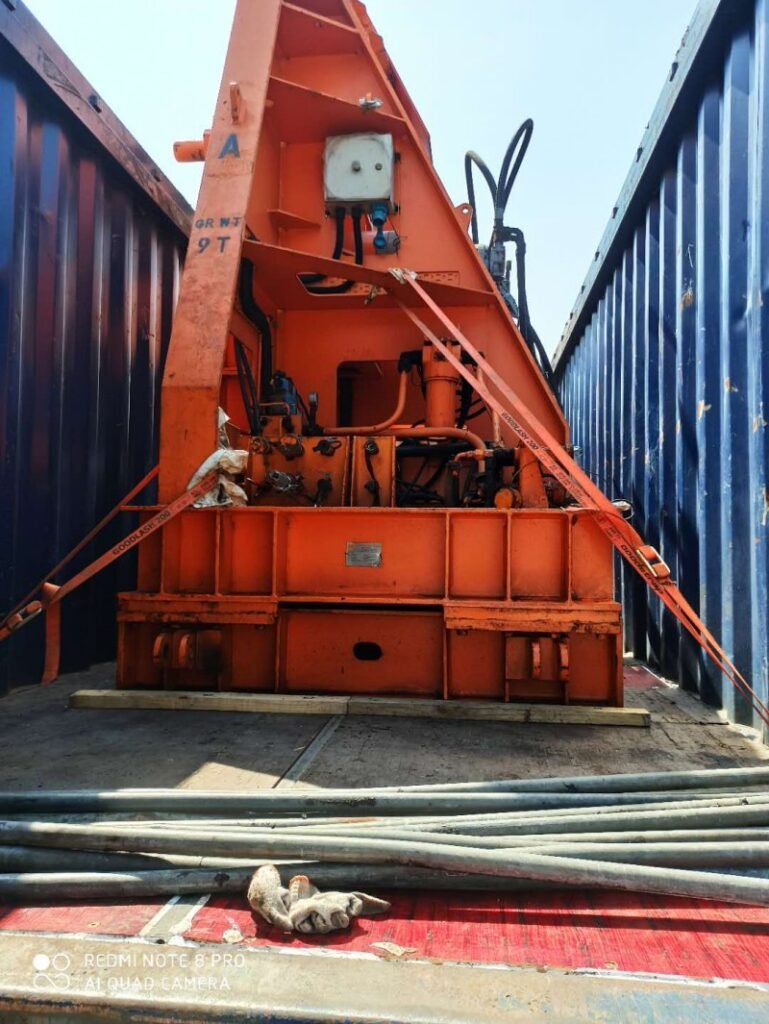
Chain lashing is compatible with heavy, rigid beams of high tensile strength, and timber blocking is used to stop any sliding at the bottom. Taller or lateral pieces are held sturdier on cross-lashing.
Effective methods:
| Securing Method | Application | Benefit |
| Chain lashing | Heavy beams | High tensile capacity |
| Timber blocking | Base stabilization | Prevents sliding |
| Cross-lashing | Tall structures | Lateral restraint |
Insert lashings into container-approved points with the even tension. The action of the sea adds to the stress on long distances, and it is well to check the play before leaving.
Environmental and Corrosion Considerations
Corrosion on steel structures will be more susceptible in open tops as it will be exposed to rain, spray, and saltwater, and protective measures should not be compromised.
Check pre-shipment finishes, repair any parts. Where practicable, use breathable protective wrapping or VCI films to ensure that there is tarpaulin sealing but it is limited in damp voyages. It is better not to cover the moisture, which promotes rust.
These actions are effective in preventing rejection on arrival and structural integrity in coastal or long-haul routes.
Common Mistakes in Steel Structure Export
Misplaced misdemeanors can sometimes make a simple delivery an expensive nightmare.
Frequent pitfalls:
- Use of incomplete assembly height, which results in the occurrence of unexpected OOG surcharges or rejections.
- Poor floor reinforcement, which results in dents or long-term deformation.
- Lashing points are not utilized adequately and risk of cargo movement below the sea.
- Neglect of length clearance in ports or at inland routes.
- The ocean leg should consider road transport constraints.
Some of these ramifications can include structural deformation, damage of cargo, port delay, insurance claim, and a project time overrun. Most problems can be noticed during a thorough pre-planning.
Conclusion — Steel Structure Shipping Requires Engineered Planning
Export in open top containers Steel structures require a careful check of certain dimensions, certain weight positioning, cub crane loading, and appropriate securing. During the international shipment, the safety of transportation, and the integrity of structures is guaranteed by structured planning. The ability to take every step with a risk-oriented attitude, not expecting rigidity to be equal to simplicity, is a sure way of achieving consistent results when applying it to both fabricators and contractors.