
The transport of construction machinery in open top containers will involve organized planning in the construction of the engineering design, the lifting and stabilizing of the loads, rather than the use of the height as a basis of selecting the container to be used. During the years that I used to organize international loads on the same excavators, wheel loaders, etc. there were a lot of occasions that a project was delayed or destroyed due to the fact that the respective teams did not treat these loads as heavy, thus, handling them like normal items. Construction equipment often goes higher than the interior of a dry van container; at about 2.35- 2.39 meters, open top types represent an open rooftop where vertical crane loading can occur. Such an arrangement requires OOG (out-of-gauge) declaration, accurate structural appraisal and acceptance by carriers to prevent port rejection.
The construction equipment people assume that once the tracks or attachments are removed, it can be shipped like regular freight. As a matter of fact, excavators, loaders and cranes have a tendency of lopsided weight distribution, heavy centers of gravity as well as complicated lifting points that make the task difficult. Shipping of safe construction machinery in open top containers requires accuracy in the dimension verification, weight balance and force designing.
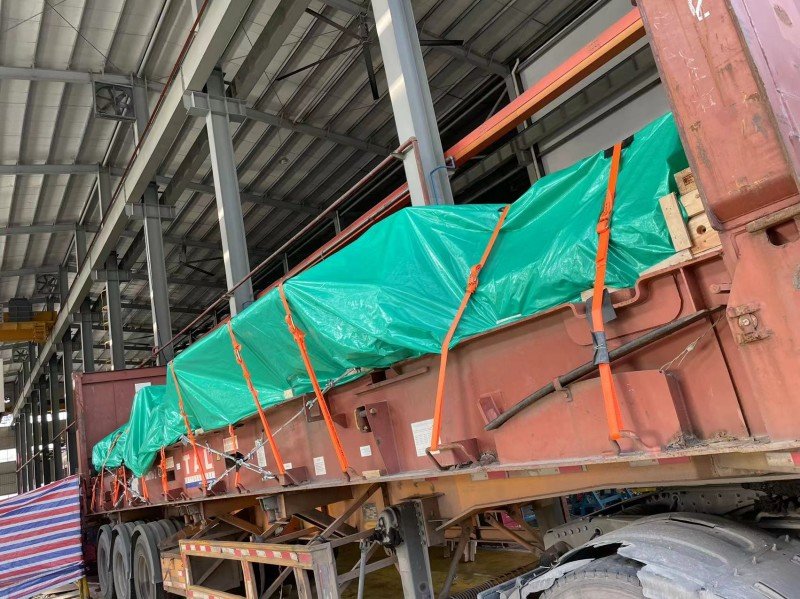
When Is an Open Top Container Suitable for Construction Machinery?
An open top container is the feasible option in cases whereby construction machinery is higher than the normal height of a container, but fits into the width constraints, to enable containment along the sidewalls to improve stability to the lateral direction.
Top loaded Tarpaulin cover Open top containers – generally 20ft or 40ft tankers with a permanent hight of approximately 2.342.38 meters- are the best in top loaded cargo. Lifting heavy objects that will not pass through the usual door is made possible through crane access. Removable parts, such as booms or cabs tend to decrease the overall size significantly to make this an option.
The following is a rough list of sorts depending on types of common machines:
| Machinery Type | Open Top Suitable? | Reason |
| Mini excavator | Yes | Over-height manageable; compact footprint fits well with sidewall support |
| Wheel loader | Often yes | Width usually fits within sidewalls; boom removal helps control height |
| Tower crane components | Case-by-case | Structural evaluation required; may need partial disassembly |
| Wide tracked bulldozer | No | Flat rack may be required due to excessive width or track overhang |
Setting up an effective construction machine transportation in open top container requires dimensional checking and center of gravity check prior to selection of the container. Failure to carry out this step usually brings about last-minute changes to alternative options such as racks which are more costly.
Dimensional and Structural Assessment
Proper dimensional and structural evaluation is the cornerstone of any successful open top shipment because get this case wrong and the whole move will be rejected or have to be restated at high cost.
Establish the dimension of the equipment prior to any other thing. This consists of total height including cab or boom (where not removed), and the widest point of width, and projections such as counterweights. Do away with removable elements where you can, most manufacturers create booms, tails, or shanties that are easily dismantled in order to reduce height. Forgetting about skid bases or pallets.
The following are the key assessment items:
- Total height- Determines the OOG classification and projection on the top rail.
- Width check – Has to remain within sidewall constriction (usually = 2.35 m internal)
- Weight confirmation — Compares to limits in the floor load (usually 7-8 tons on each square meter dispersed).
- COG determination – Vital to maintain the stability in the lift and sea transit.
- OOG projection – Over top rail must be carrier and port approved.
Improper measurements are common grounds to have the shipment rejected at the terminal point as the carriers are strict in their OOG tolerances to have a stable vessel.
Weight Distribution and Floor Reinforcement
Having a disbalanced weight pattern in construction machines that are heavy will lead to concentrated point loads which can deform the floor of containers in case they are not taken care of.
Construction equipment is seldom perfectly balanced in the way of rear-heavy loaders or front-weighted excavators redistributing the weight to a certain location is stressful. Open top floors are also reinforced yet they still depend on being in line with the supporting cross members. Unless you spread the load, you may dent or crack.
Risk factors and preventions are generally common:
| Risk Factor | Consequence | Prevention |
| Concentrated foot pressure | Floor deformation | Load spreading beams or steel plates |
| Rear-heavy configuration | Road imbalance | Axle planning and COG adjustment |
| High COG | Tipping risk | Reinforced base and low positioning |
The general asymmetry of the distribution increases the stress dynamics in ocean roll or road transfers during transfers. Timber beams, steel plates or dunnage should be used so that weight is evenly distributed on the floor.
Crane Loading and Positioning
The crane loading requires a written lift plan- the rush or improvised lifts are some of the most common causes of damage in the OOG shipments.
Install approved lifting points on the machine (follow manufacturer specifications of rated pads or eyes). The sling angles should be optimized to a range of 30 60 as to minimize the compressive forces; steeper angles may cause crushing. A spreader beam is used to keep the load evenly distributed and avoids swinging.
Key steps:
- Supervisory position spotters.
- Lower slowly and controlled
- Overlay perfectly with base supports or dunnage.
Swing impact caused by the wind or crane movement, unexpected drops in case the slings fail, and misalignment that will give stress to tracks or tires are some of the risks. Always use a written lift plan – no exceptions.
Lashing and Securing Construction Equipment
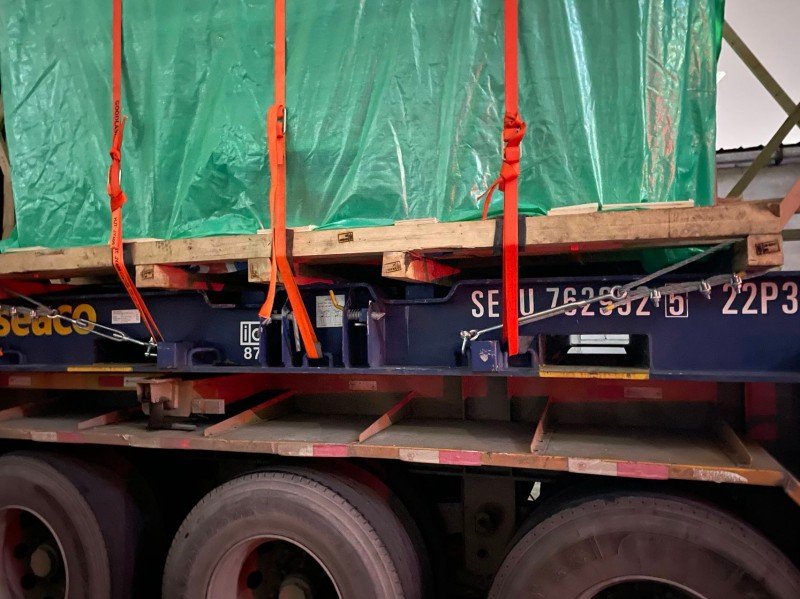
Lashing should have to resist all the forces anticipated that may be onward, backward, lateral and vertical, particularly, during heavy sea conditions.
Chain lashing gives high strength required by excavators, loaders; use together with cross-lashing on high machinery to eliminate sidewise movement. Timber blocking and bracing maintain the base and redistribute the loads.
Effective methods:
| Securing Method | Application | Benefit |
| Chain lashing | Heavy excavators | High strength and durability |
| Cross-lashing | Tall machinery | Lateral restraint |
| Timber blocking | Base stabilization | Load distribution and anti-shift |
The rolling, the pitching and the surging of the sea transport may increase the weight bearing by several times of the balance in statical loads. Tie everything down to container tie down points with adequate tension and examination.
Environmental and Operational Risks
The true threats to construction machineries in open top containers are environmental exposure and route limitations.
Unless tarpaulin covers are well sealed, rain can seep into the cover causing corrosion of the metal components. Tall gear enhances the resistance to the wind, which is dangerous to tipping on the inland legs. Road restrictions and bridge clearances as well as road axle weight limits usually necessitate route surveys.
The protective measures are reinforced tarpaulins, edge protectors and weatherproof wrapping of sensitive parts. Never combine inland movement, a second occupation with the ocean falls, an entirely different thing.
Common Mistakes in Construction Machinery Shipping
The commonest mistakes are related to under estimation of engineering of such loads.
- Extracting the items that can be removed, but classes them as links – creates large classification errors.
- Disregards COG shift post disassembly – leads to instability in the lift or transit.
- Miscalculation of reinforcement of floors- leads to claims of deformation or damage.
- Inadequate lashing -enables cargo movement and possible failure of the container.
- Ignoring route prohibition – causes an inconvenience of delays, cash penalties, or rerouting.
These consequences include the cargo being damaged during a shift, ports are experiencing problems, boring delays, and insurance claims. Most of these are avoided through pre-shipment inspection.
Conclusion — Construction Machinery Requires Structured OOG Planning
Shipment of construction machinery on open top containers requires critical checking of dimensions, engineered loading, crane lifting, along with lashing. Safe transport, compliance with the regulations and less risk of the operations of the heavy project cargo are guaranteed with the help of proper planning. Thinking in an organized, engineering-style fashion when approaching such shipments helps to cushion the equipment as well as the timing of a project- experience has taught us that such shortcuts rarely pay off in this business.