
Movement of mining equipments in open top containers is a systematic procedure in engineering that entails a dimensional authentication, load stability examination and intended unloading, which does not entail the choice of a container, such as one with detachable roofing.
Mining equipment is usually heavy, tall, or of unusual styles and so the standard dry containers are not practical. The open top containers can be crane loaded with tall or non-standard equipment and their top can be directly accessed without imposing items using side-end doors. Nonetheless, each shipment can be discussed as OOG (out-of-gauge) when projections do not meet the ISO requirements, requiring accurate structural assessment, IMDG/CTC compliance examinations (in case there are any hazardous residues) and carrier certifications.
One of the most frequent misconceptions is that mining gear may be loaded in the same way the usual industrial machinery is loaded. In the real world, mining equipment is usually lopsided, heavy in the Centre of Gravity, and makes lifting a complicated affair and thus turning an otherwise routine undertaking into a risky exercise unless this is addressed.
Open top containers also need engineering analysis and structural fortification, as well as regulated loading before qualified and safe shipment of mining equipment. An effective shipping of mining equipments in open top containers commences with dimensional check and center-of- gravity selections before ultimate container acceptance.
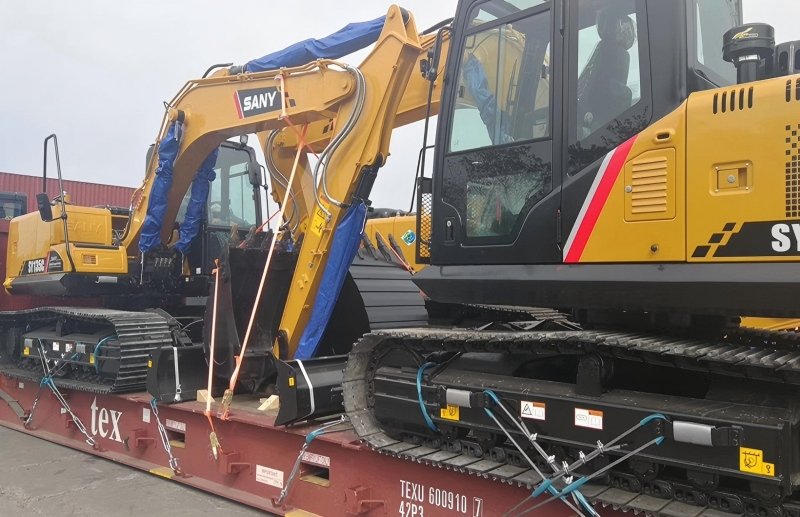
When Is an Open Top Container Suitable for Mining Equipment?
In mining equipment that may have a tall height that is above the normal internal limits (normally is about 2.39 m) but the width and length are within the container boundaries, and when the task of loading is by crane, open top containers are suitable.
They contain sidewall stability in a lateral direction, moderate OOG export above the top rail (often to 0.3006 m depending on carrier regulations), and contain better than flat racks some profiles. Access of crane is necessary when machine has no forklift pockets or when its loading point is highly concentrated at the top.
| Equipment Type | Open Top Suitable? | Reason |
| Hydraulic drill rigs | Yes (if width fits) | Over-height but stable base; crane loading aligns with certified points |
| Compact crushers | Yes | Heavy but centralized weight; sidewalls aid against lateral shift |
| Wide conveyor sections | No | Width restriction exceeds 2.44 m internal; flat rack preferred |
| Oversized excavator arms | Case-by-case | Structural assessment needed for projection and COG alignment |
In cases of borderline cases, a test must be done with on-site measurement and 3D model to ensure steadyness and fit.
Key Engineering Challenges in Mining Equipment Transport
The transportation of mining equipment presents special to structure and operation challenges, which common freight barely faces.
The bulk weight (usually 20-40 tons per unit), asymmetrical weight distribution caused by booms or counter weights, long arm, chassis and weak hydraulic systems, which are easily damaged by pressure solicitation and binding removable components only add complexity. In nearly every case, custom blocking is necessary–generic dunnage is of little use in such cases.
- High COG>Reinforced base support, low-level securing.
- Focal foot pressure- load spreading beams to prevent floor damage.
- Long components → Secure fixing at various locations.
- Hydraulic protection → Wrapping and pressure relieving.
Such problems require early intervention of a cargo engineer to plot lifting points, COG, and reinforcement requirements.
Weight Distribution and Structural Reinforcement
High weight distribution in open top container mining equipment vehicles often lead to structural damages, container deformations or even tipping when handling.
open top floors have determined load limits (generally 47 tons/running meter (depending on CSC plate) with cross members aligned in force under locations of loading. Emphasized loads cause stress, and buckling can easily occur along the floor; and an unevenly distributed lateral load poses a risk of tipping the vessel through roll or truck turns.
| Risk Factor | Consequence | Prevention |
| Point load stress | Floor deformation | Steel plate reinforcement + timber spreaders |
| Uneven lateral load | Tipping risk | Balanced placement + cross-lashing |
| Rear-heavy cargo | Road transport imbalance | Axle load planning + forward COG shift |
It is important that load spreading timber beam (at least 150 150 mm hardwood) or hard steel plates are used, to spread pressure among numerous cross members.
Crane Loading and Lifting Procedures
Crane loading of mining equipment is the safest and most accurate in the case of the open top containers; however, only when done under strict procedures.
Certified lifting points identified should be implemented based on OEM drawings and not improvised. Slinger beams eliminate sling crush and preserve vertical lift and angle of sling must not exceed 60 degrees to provide limited horizontal forces. The decrease is controlled using tag lines and coordinating spots to avoid hitting the walls of containers.
Very long or unbalanced pieces (e.g. long booms) will require dual-crane lifting, as otherwise even a small area would become overloaded, leading to poor attitude and space utilization. Stability is ensured by pre-lift tests and load tests.
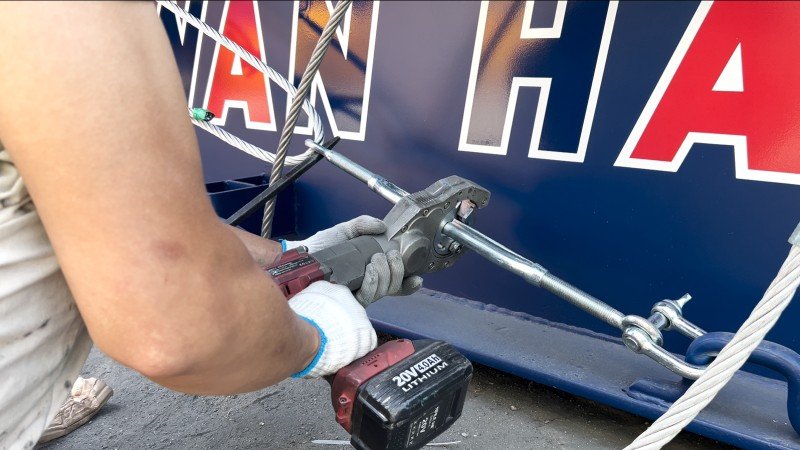
Lashing and Securing Heavy Mining Equipment
Dynamic forces of the sea, roll, pitch and heave must be resisted by lashing which increases the stresses on heavy mining cargo many times over those experienced by road transport.
Chain lashing gives great tensile strength of extremely heavy units; timber blocking deploys underside stresses; cross-lashing keeps tall equipment in place. In OOG projections uplift needs to be prevented with added top-over or loop lashing.
| Securing Method | Suitable For | Advantage |
| Chain lashing | Very heavy cargo | High tensile capacity |
| Cross-lashing | Tall equipment | Lateral restraint |
| Timber blocking | Base stability | Load distribution |
It is possible to several times (1.82.5X) to increase phenomena under conditions of extreme load on the sea (including cases of shortage of class-adequate plans, e.g., required by the CTU Code).
Environmental and Operational Risk Factors
The exposure of OOG mining cargo is peculiar to open top loading, particularly during extended journeys to odd locations of mines.
The ingress of rain and dust requires reinforced tarpaulin systems (two-layered, with sides tied) and complete protection wrapping of hydraulics/ electronics. The risk of over-height cargo carried by the wind is the loss of the lashings, port handling may require complexity (crane reach, berth congestion) with the prospect of introducing delays.
Routine weatherproofing of pre-shipment and risk analysis of routes are uncompromising.
Common Mistakes in Mining Equipment Shipping
Most of the problems encountered in the mining machinery transportation are as a result of not factoring the complexities.
The consequences of identifying the concentration of weight below the required level are floor failure; not taking measurements of removable parts causes rejection at last minute; lack of reinforcement of the floor determines deformation; the wrong slinging angle during crane lift may result in drops, and ignorance on route clearance regulations leads to road block or fines.
It may result in structural damage, delay in shipment, disagreements in insurance, and a drastically higher cost of operation, which can, in many cases, be anticipated through early input in the engineering phase.
Conclusion — Mining Equipment Requires Structured Transport Engineering
The transportation of mining equipment by the open top containers requires special attention to the dimensional checks, the weight distribution that is engineered, the crane lifting, and lashing. Planned organization guarantees stability of cargo, regulatory adherence, and consistency in the delivery of the cargo to the project locations. Premature evaluation of OOG factors and load forces as well as environmental exposures averts most of such incidents encountered during the transportation of heavy equipments. When all the arrangements are developed at the initial stage of the project, the risk reduces to a minimum zero- either machine has been transported properly and on time.