
Industrial machinery often surpasses the internal height of a standard dry container, and it is only possible to top-load using crane. Often used are open top containers which are used to access the overhead handle such as heavy machinery such as turbines, generators, presses or large engines that are unable to squeeze through side doors.
However, a common assumption that many teams make is that in case the equipment can fit on the footprint of the container, it can be shipped without a follow-up. As a matter of fact, industrial equipment have never been found to be easy in terms of structural, weight distribution and stability issues that require intense engineering consideration. The key to the successful transportation of industrial equipment in open top containers lies in organized scheduling, restrained crane hoisting, and calculated securing and not dimensional estimates.
Transporting industrial equipment using open top containers has to start with the check of dimensions and lifting capability analysis prior to choosing the end result container.
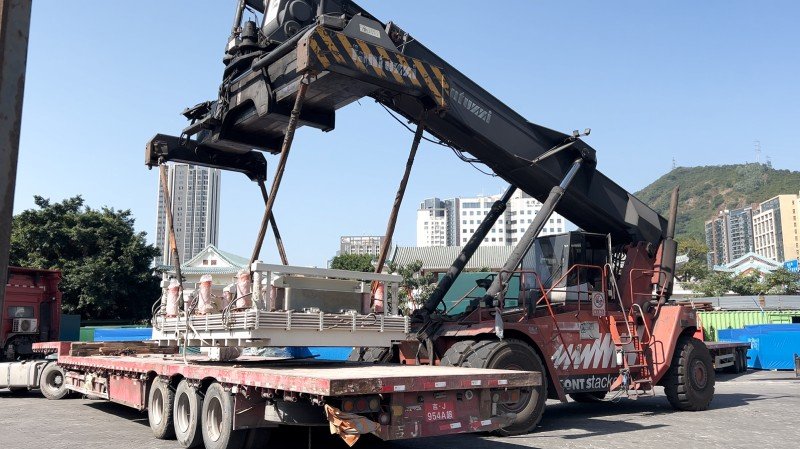
When Is an Open Top Container Suitable for Industrial Equipment?
An open top container is the correct option whereby cargo height is the main limiting factor, and the cargo width and length are within acceptable values and where the top loading via crane is possible.
Open tops are used with industrial equipment that is more than the normal heights of containers (normally about 2.382.39 m internal) but has the advantage of both protecting the sideswalls and containment. They are an excellent fit in small but tall objects that have a firm foundation. Nevertheless, a flat rack is often required in case width goes beyond the door or roof opening requirements.
Here’s a quick reference:
| Equipment Condition | Open Top Suitable? | Reason |
| Slight over-height | Yes | Roof removable for crane access |
| Over-width | No | Flat rack required |
| Heavy but compact | Yes | Better containment and protection |
| Extremely irregular shape | Case-by-case | Structural assessment needed |
In the case of heavy machinery, open top shipping, the choice will depend on whether the crane loading process offers a safer, more accurate position than side-entry loadings.
Engineering Considerations Before Shipment
Most rejections at the terminal or during transit can be avoided by having proper preparations and this should begin with verifiable data rather than making assumptions.
Significant aspects of engineering are ensuring total weight verification with container payload (usually 2830 tons on 40 open top) and locating center of gravity (COG) accurately to eliminate tipping effects and verifying floor load to ensure the vehicle is not point-loaded to avoid destruction. There is no compromise on the correct height of the OOG at its floor level, the route and port restriction review.
Use this checklist:
- COG locating –Avoids designation when lifting products and sea-sailing.
- Load distribution – Prevents high density-stress on the floor.
- OOG declaration—Ahead of carrier approval.
- Lifting plan – Provides the safety of the crane operation.
- Clearance on routes – Takes into consideration bridges, tunnels and port gantry limit.
Failure to follow these steps can either result in the operational rejection, delays or compulsory rebooking.
Crane Loading Procedures for Industrial Equipment
Crane loading should be systematic in order not to induce structural damage or instability- hurry crane lifting is a common cause of problems.
The machinery should have certified lifting points; do not make them up. The role of spreader beams is in ensuring that there is uniform dispersion of loads and correct sling angles (usually 45 to 60 degree to reduce compression forces). Move via control descent at leisure, and position pointkeepers to position without touching container sides or corner posts.
Some of the major risks encompassed swinging loads, which can hit the buildings, imbalance due to being out of balance and unplanned descent. Such things can be brought to almost zero in a well-coordinated group.
Lashing and Securing Heavy Machinery
To overcome dynamic sea forces not only the weight but also the forward surge, rolling, pitching, must be countered by securing.
Chain lashing gives heavy machinery a high level of tensile strength and timber blocking distributes the load and stabilizes the base. Cross-lashing inhibits the lateral movement, and balanced tension inhibits the form of loosening during vibration.
| Securing Method | Application | Advantage |
| Chain lashing | Heavy machinery | High tensile strength |
| Timber blocking | Base stability | Load spreading |
| Cross-lashing | Lateral restraint | Prevent tipping |
To secure the load of industrial equipment containers all lashing points need to be tightened evenly- unless otherwise as may happen due to voyage modifications.
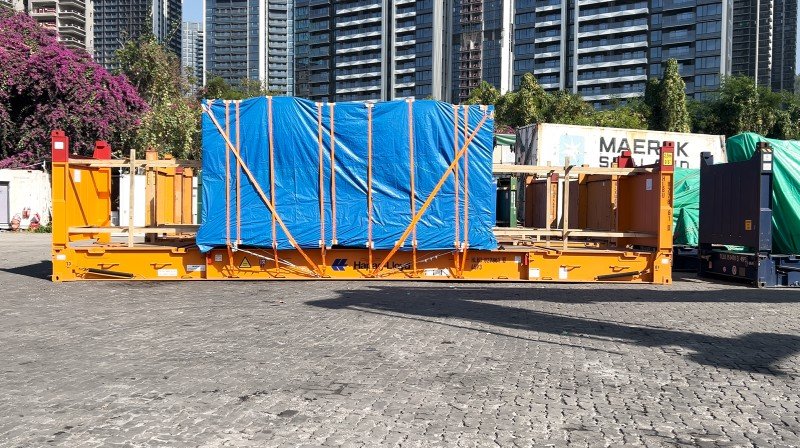
Environmental and Structural Risk Factors
Cargo is left exposed to elements through open tops hence the need to plan against real world vulnerabilities.
The exposure to weather risks any water that enters through the tarpaulins in case they tear off or have improper fittings, tall machineries are prone to the forces of wind which magnify the sway. Axle balance issue on trailers is added by inland transport.
Industrial equipment can be expensive to replace and lead times can be long – the break of projects stop projects until it can be fixed. The mitigation begins with strong tarpaulin fastening and route-related wind tests.
Common Mistakes in Industrial Equipment Shipping
Errors that are made in form of short cuts in planning and execution are the most destructive ones.
Failure to estimate the height of packaging results in last minute alterations; failure to reinforce the base beforehand results in damage of the floor; selecting the container prior to measuring it on the site may bring the actual rejection. Neglecting the road clearance leads to detour of route whereas poor securing encourages the cargo shift.
Some of the results are structural damage, a delay at the port, claim of insurance and and an increase in costs. These are the things that almost always lead to not doing a detailed pre-shipment survey, as was the case in my experience.
Cost Implications for Industrial Equipment Shipping
Engineering preparation is predictable on costs skipping it attracts supplements.
Special handling OOG surcharge, crane charge at the origin/destination, and securing materials (chains, timber and lashing gear) and port charges at the destination on oversized lifts. Premiums are increased with value and profile of risk.
Careful preparation, right statements, and efficient guaranteed get-ups make them not to re-handled, make it take too long, or encounter loss in the form of claims that greatly outweigh initial effort.
Conclusion — Industrial Equipment Requires Structured Transport Planning
Container transportation of an industrial machinery cannot be simply done in an open top container through mere dimensional fit. Regulated engineering evaluation, controlled loading, and OOG industrial cargo transportation in a structured fashion are required to safeguard the cargo integrity and ensure a high degree of project execution security.
The safety of the movement of heavy machinery is based on dimensional verification, stability analysis, and risk-oriented securing. When a group of people approaches crane loading heavy industrial gear and large machinery sending with this attitude, the results become significantly better – few or no damage, time lost and unpleasant surprises.