
In open top container shipping, weight distribution directly affects cargo stability, container structural integrity as well as the safety of transfers of the transport. Although the overall cargo mass remains significantly less than the maximum payload per container, asymmetrical loading can overstress particular floor, beams and/or castings of corners or cause an unsafe level of imbalance. This risk is magnified with OOG and over-height cargo such as the heavy machinery being sold by them; higher loads with higher center of gravity increase the chances of the cargo tipping during rolling of a vessel or road transportation.
Several planners even think that they cannot go above the payload limit and it will ensure safety. Practically, unacceptable distribution frequently causes localized stresses which destroy the floor or result in movements on the sea. Open top shipping is an engineering issue of proper weight distribution which ensures safety, compliance, and integrity of the cargo during sea and inland transportation.
In the case of complex shipment, the open top cargo weight distribution is planned to be engineered to provide the optimal centration of the overall weight and the structural loading before delivery at a port.
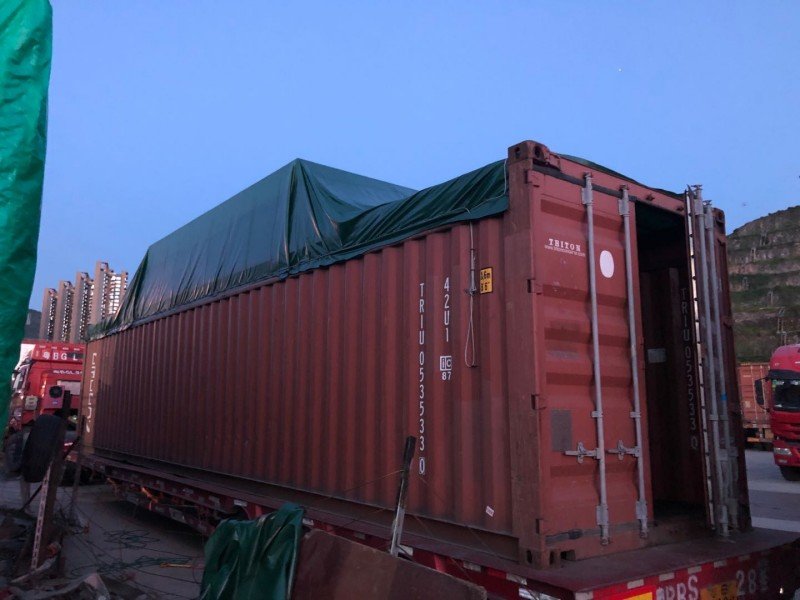
Understanding Container Floor Load Limits
The floor load capacity of open top containers is more of a surprise to a lot of people; it is not equal to maximum payload.
Maximum payload is the maximum permissible weight of the cargo (about 26,000 to 28,000 kg is typical 40′ open top weight depending on carrier and construction), yet floor load limit is about the amount of maximum pressure per square meter or running meter. Open top containers tend to be similar to the floor strength used in normal dry vans with wooden floors bearing a range of around 4.5 tons per running meter on 20ft containers and 3.0 to 3.5 tons per running meter on 40ft containers. Floors made out of steel can bear more point loads.
The container floor is based on the use of cross members and longitudinal beams at the bottom. The point loads like feet of heavy machinery placed on small localized sections introduce sharp localized stress which could crack a piece of timber or bend a piece of steel. Weight is distributed making loads less risky.
Another thing that machinery exporters often miss is that a machine leg can go beyond the point-load tolerances at even the total weight is within limits.
| Factor | Explanation | Risk if Ignored |
| Maximum payload | Total allowed weight (including tare) | Overloading overall |
| Floor load limit | Weight per square meter or running meter | Floor damage or collapse |
| Point load | Concentrated weight on small area | Structural stress or deformation |
| Load spread | Even distribution across larger surface | Stability improvement |
It is important to never exceed the rule and keep in mind to measure the size of the contact of the machine bases and spreaders should be used when necessary.
Center of Gravity (COG) and Stability
High center of gravity is a serious risk factor that may cause tipping in open top container shipping.
The up-lift in the COG of over-height cargo is inherent to OOG shipments and causes the load to be more vulnerable to sideways effect due to lateral force of vessel rolling or road turns. This is aimed at maintaining the overall COG as low and centred as can be and, preferably, aligned to the centreline of the container in the longitudinal and lateral directions.
The same prevents tilt by balancing the loads symmetrically, and increases the pressure on the lashing of asymmetrical loading, as well as the opportunity to roll-over during transit at sea. Motion of the vessel increases any offset: under severe weather, the slightest irregularities become multiplied.
Stability Elements and Required Actions
- Determine COG – Check before loading with drawings of the engineering or calculations.
- Bring COG to centerline – center within acceptable range of 5-10 percent.
- Test lateral balance -Prevent roll by examining side-to-side symmetry.
- Take into account height effects- Change lashing with higher loads.
- Checks during loading – Checks after positioning.
The lack of consideration of COG in loading of heavy machinery containers usually results in rejection at ports or insurance problems.
Longitudinal and Lateral Weight Placement
The issue of longitudinal and lateral balance is not confined to ocean legs–it has a direct relationship with transport on land.
Additional front weight causes the load to be diverted on the tractor axles, which have chances of being imbalanced or there are possibilities of violating bridge formula. Excessive rear weight causes the trailer to be tail-heavy, thus difficult to handle and brake. Lateral imbalances cause the risk of tipping, in particular on curves.
Compliant with the local regulations (usually more strict than sea regulations), the axle weight distribution is required to comply with road regulations. The improper placement also amplifies the stress of lashing and may result in container twisting.
| Placement Issue | Potential Consequence |
| Excess front weight | Trailer imbalance, axle overload |
| Excess rear weight | Handling instability, braking issues |
| Uneven lateral load | Tipping risk during turns |
| Asymmetrical placement | Increased lashing strain, stress |
Placing of the plan with consideration of the road legs- attempt to have a balanced distribution at the front and back as well as the sideways.
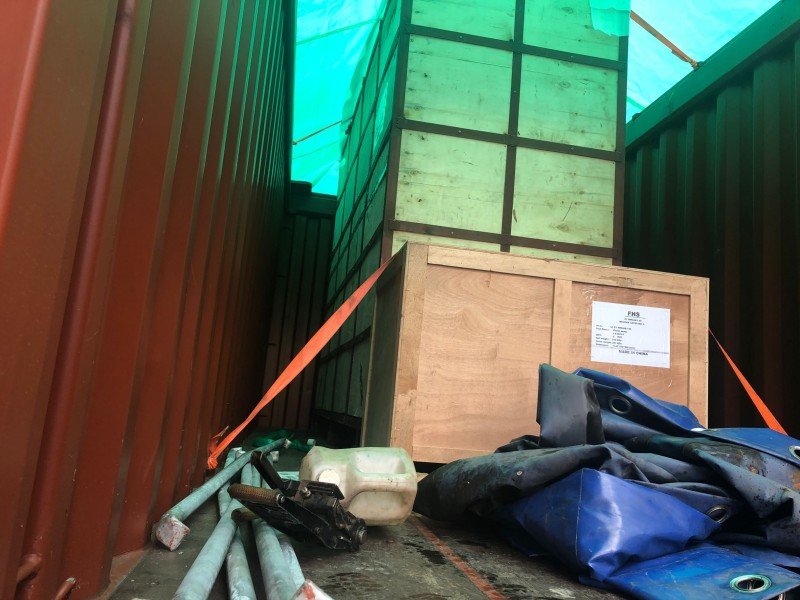
Over-Height Cargo and Load Stability
There are special stability concerns of wind and movement with over height cargo shipped in open top containers.
Large loads attract more wind resistance, and cause lateral forces when rolling the vessel. This increases the tipping in case the base is not wide enough or strengthened. The result of a narrow footprint is forces that are focused upwards increasing COG and instability.
Base reinforcement is critical: broad skids / outriggers distribute the load, reducing effective COG. Bracing and blocking should be effective to overcome sway, out of which special care of the diagonal forces.
Machinery with tall sides requires broad support of the base, preferably at least as wide as the height of the machinery.
Use of Blocking and Load Spreading Materials
Soil blocking and dispersion convert the possible point loads to safe distributed loads.
Timber beams continue to be used in load dispersion under heavy machinery whereas the steel plates deal with the extreme point pressures. Anti-slip mats provide friction to the drive to avoid the forwarding and composite blocks provide the light weight stability.
Select according to cargo: large loads of the points of the cargo should be steeled; medium-weight machinery should have rubber mats.
| Material | Purpose | Suitable For |
| Timber beams | Load spreading | Heavy machinery |
| Steel plate | Floor reinforcement | High point load |
| Rubber mat | Friction control | Medium-weight cargo |
| Composite blocks | Stability enhancement | OOG cargo |
International shipments should use treated timber that is in line with ISPM-15.
Inspection Before Port Delivery
Before they turn into problems of the voyage, pre-delivery inspection reveals problems.
Check total weight against records, ensure that floor stress remains within control, recheck the COG position, check the lashing tension and record all this in photos.
Inspection Checklist
- Floor integrity – Eliminate collapse through spotting deformity or cracks.
- COG confirmation Do not tip through last measurement.
- Lashing tension – Avoid (prevent) motion shift.
- OOG marking – This is to guarantee regulatory compliance.
Is an in-depth inspection that will reduce the chances of rejection on the terminal.
Common Weight Distribution Mistakes
Accomplished teams overlook fundamentals of weight distribution.
Machinery foot pressure is ignored causing the floor to be damaged; point loads can be spread dangerous without reinforcement. The application of symmetry in the absence of measurement brings about undetected imbalance. Under-observance of road axle limits attracts fines or offloads. Increment of the packaging weights without recalculating shifts will sum up at a very high surprise.
Examples of consequences are structural damage of the container, cargo shifting during a voyage, port rejection or insurance companies.
Conclusion — Distribution Is as Important as Total Weight
In open top container shipping, the operation of remaining within the payload limits is not the only means of ensuring safe transport; adequate distribution of weight throughout the container assembly is necessary. Cargo integrity protection, structural stress avoidance and compliance OOG transport are safeguarded by proper planning. The location of weight is usually more important than the overall mass of an object- measure it, redistribute it, and check measurements with engineering tests every time.