
Execution gaps in securing failures are a common occurrence in heavy equipment transportation and on-site supervision is the only way to discover these and rectify the faults.
The number of such incidents is too large not to be attributed to the securing plan being ineffective in principle, but associated with the loading in practice that added deviations leading to severe instability. The drawings, calculations, and approved lash plans are flawless in the office- but an environment on the site will invariably alter the result with operator decisions and last minute modifications.
The faults that are made when the equipment is loaded one way or the other usually compromise a well-planned securing over being executed in heavy equipment lashing to the extent that supervision on site is necessary. Even small slippage may result in consistent degradation, movement or worse in transit of ocean or roads without a real time person to check the placement, tension and the order of placement.
Why Heavy Equipment Lashing Is Highly Sensitive to Execution Errors
Small mistakes cannot be forgiven in heavy machinery like they may be forgiven in the case of palletized goods.
The magnitude and weight of the job, such as excavators, turbines, or press frames, 50300 tons, magnifies any mistake. Even a few centimeters in load positioning may cause a shift in the center of gravity to the extent of causing the distribution of forces across Lashings to be uneven. Poor contact of the equipment base and the flat rack deck will decrease friction and stability. Skewed tensioning of a single or two turnbuckles permits micro-motions which increase to slackness during roll or road vibration in the vessel.
Deviation is not tolerated in heavy equipment due to the fact that their geometry is fixed and frequently irregular: protruding booms, non-uniform undercarriages, high centres of gravity cause forces to focus in a short time. A 5to 10 percent motion of imbalance may cause total loss of control in long trips.
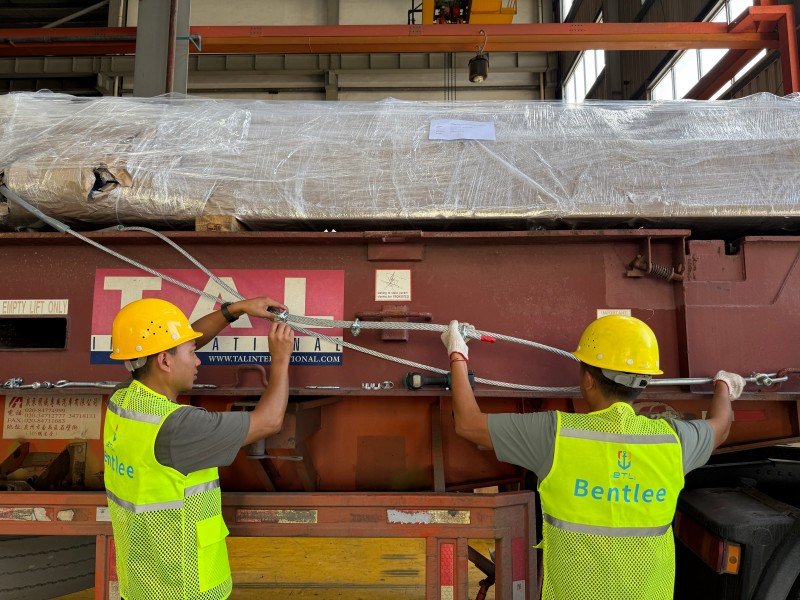
Common Execution Deviations That Cause Lashing Failures
A majority of lashing failure is rooted in the repeatable problems on site as opposed to exotica.
The most common deviations in project cargo loadings, which I have encountered are the following:
| Execution Deviation | What Goes Wrong | Resulting Risk |
| Incorrect lashing angle | Force misalignment | Reduced restraint |
| Uneven tensioning | Load imbalance | Progressive loosening |
| Misplaced blocking | Inadequate base support | Sliding or tipping |
| Skipped checks | Undetected errors | Hidden instability |
These are not extraordinary omissions, but are common expedient measures in time constraint or misunderstanding between planners and the loading force. An angle, which should be 45 o, is defined at 30 o due to space limitations on deck. Tension is eschewed rather than measured using a dynamometer. Blocking timber moves a little in making the final adjustments and is not re-tested.
Why Approved Securing Plans Alone Are Not Enough
Plans propose an ideal situation- site reality seldom corresponds to the suppositions.
According to the design purpose, the entire footprint may be required to be perfectly touching the deck, but rust, paint accumulation, or slight deformation of the equipment base form uneven support. Cargo may contain some surprises in the form of protrusions or last minute changes that change the originally expected contacts. The lashing sequence will be modified to suit the weather, or other limitations in the lighting or access, which were not foreseen in the office.
Real-time judgment becomes necessary since the conditions at the site introduce variables which cannot be completely incorporated by any static calculation: the value of the actual friction coefficient, the dynamic flex under load of the deck, or the technique of the operator when it comes to producing tension. Supervision fills That gap between the theory and practice.
The Role of On-Site Supervision During Loading and Securing
Proving a plan into real execution is done through on-site supervision.
The major activities of the supervisor concern:
- Decision-making: checking that the position of compensating loads and alignment is accurate with the plan- checking the offsets and making sure that the center of gravity is within limits.
- Monitoring the lashing order to ensure that problematic restraints are installed (base lashings preceding diagonals, and so on).
- Watching tension built up gradually with measuring instruments, not by free guessing, and correcting every starting point of deviation.
- Enabling open communication between the engineering team (remote) and the ground operators.
This personal presence captures the problems before they are irreversible- something that cannot be effectively done without taking a look or viewing photos.
To have systematic implementation and management that will consistently seal these gaps, integrating professional equipment securing services early in the project helps enforce discipline from planning through final lashing.
How On-Site Supervision Reduces Transport Risk
Supervision is an active risk control that eliminates the growth of errors.
Early warning of the lack of alignment prevents the occurrence of unequal force which may overstrain selected lashings. Progressive tension checking eliminates slack build-ups throughout transit. A detailed last check before the hatch is closed or the departure process reveals concealed instability that may not be detected until it occurs a few days in rough seas.
The following is a brief outline of the activities that are of key concern and the risks they mitigate:
| Supervision Activity | Risk Mitigated |
| Load alignment check | Uneven force paths |
| Tension verification | Slack development |
| Final inspection | Undetected instability |
These measures directly reduce the chances of damage, insurance claims, vessel delays or in the worst worst, loss of cargo off-loading.
Integrating Supervision Into Professional Securing Execution
Supervision should be organized and methodical rather than an optional add-on or last minute solution.
Professional systems incorporate control measures at each level: before loading a survey, during a positioning process, ladder lashing and post-securing walkthrough. This regularity lessens flexibilities and makes implementation of engineering design real in the field. Supervision does not substitute the plan, but it does complete it, and without this, the finest calculations will invariably be theoretical only.
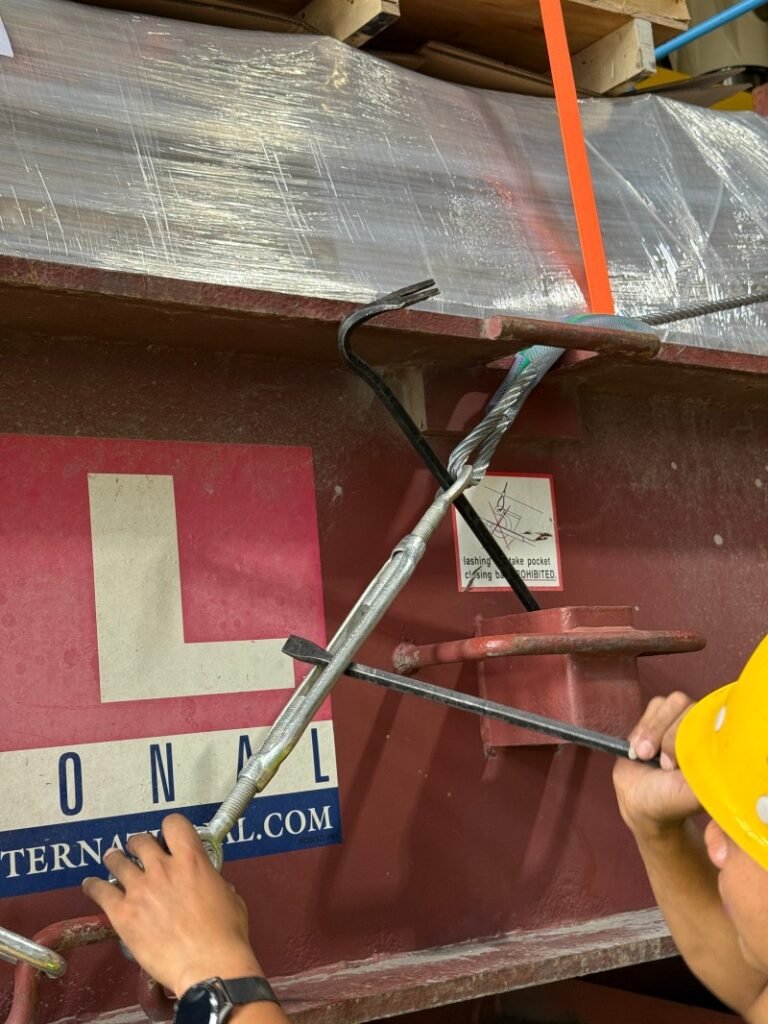
Situations Where On-Site Supervision Is Especially Critical
There are situations that require field supervision than others.
| Scenario | Why Supervision Is Critical |
| Complex geometry | Higher positioning error risk |
| High center of gravity | Increased instability |
| Tight schedules | Rushed execution |
| First-time routes | Unfamiliar conditions |
Errors are extremely reduced in such instances. An elaborate boom array or abnormally high transformer makes practically no allowance of position errors. Strict deadlines encourage crews to avoid making stops. New routes entail unknown sea conditions or road conditions which increase any securing weakness.
Conclusion — Execution Quality Determines Lashing Reliability
Both in transportation of heavy equipment, reliability is decided onsite.
The role of supervision is to fill the gap between designing and implementation, and to ensure that secure plans implement as they are supposed to work in the real life situation. It is not a formal and paperwork, it is the last line of control that ensures that minor deviations of the execution does not become significant transport accidents. On-site supervising the lashing of heavy equipment is not a cost-to-add priority, but rather a safe-keep of the asset, as well as the entire supply chain.