
Fairly, in project cargo and heavy-lift operations, cargo securing failures do not occur since the teams did not strive to achieve them. In more instances, the inclusive cause has been a misunderstanding between lashing, blocking and bracing. These are not terms or techniques that can be used interchangeably-the two deal with different forces of the mechanism and vectors of movement. The substitution of one with another or the reliance on one technique results in gaps that the sea, road, or rail processes take advantage of.
Numerous cargo securing mishaps happen not due to lack of focus, but owing to misinterpreting and usage of lashing, blockading, and bracing. The fallacy of more securing is ever safer, however it is done, is widely indulged in too many load plans. Practically, even with additional lashings mounted with no proper blocking, it is possible yet again to slide under the acceleration, and on the other hand, when only rigid blocking is applied, then an upward force with heave or vibration would not be prevented. The first step in using them correctly is to know what the various methods are capable of–and what they cannot do.
Why Understanding Securing Methods Matters in Cargo Transportation
Cargo never passes by, it also struggles against all the alterations of course and motion. During head seas or braking, longitudinal forces act in a forward/backwards direction. Lateral forces are a side-to-side force of rolling or cornering. During pitching, heaving or road bumps, the vertical forces will act to lift or compress. A targeted response is necessary to each of the vectors.
These are dealt with in a different way by lashing, blocking, and bracing. Lashing involves tension to ensure restraint, blocking involves hard physical stops against movement and bracing redistributes and re-directs stress. Use of incorrect tool or not using it at all causes the cargo to depend either on friction or chance. When I have been checking damaged flat rack and open tops shipments, the costliest allegations are linked to plans that saw the methodologies as synonyms or substitutes in a framework.
What Is Lashing and What Movement Does It Control?
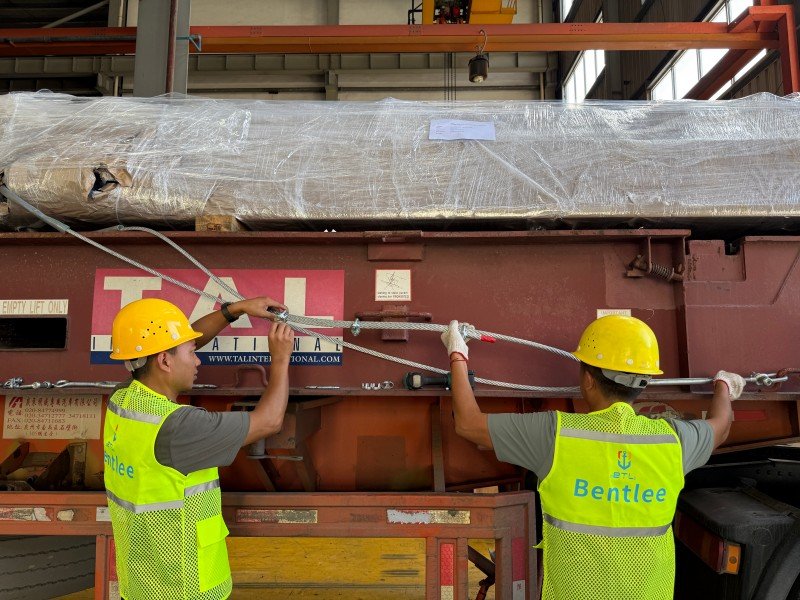
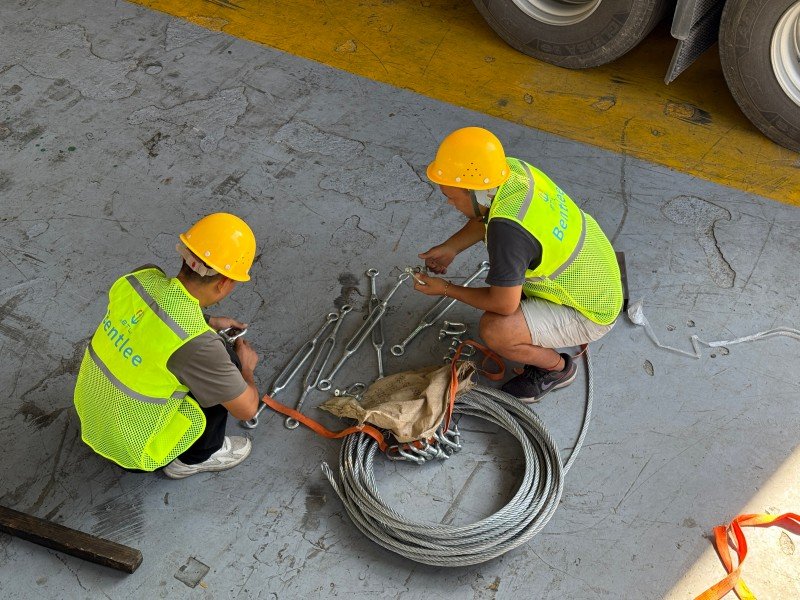
Lashing: This is the use of flexible securing materials like chains, wire ropes, ratchet straps, or webbing which are taut to produce restraint by friction and opposed force.
It operates by developing counter force that prevents to slide and tip. This strongly relies on the angle: near-vertical lashings are good at counteracting lift whereas near-horizontal ones counteract longitudinal and lateral slide. Bad angles decrease holding power by half, this I have had experience of many a time when the lashings are placed too high on the cargo, or too low on the flat rack.
Lashing on its own does not work very well when the cargo can slide by the tension point and before the lashings have secured their hold. Even long voyages can be loosened by tension due to vibration in case it is not occasionally checked.
| Aspect | Lashing |
| Primary function | Restrains movement by tension |
| Effective against | Lateral and longitudinal forces |
| Limitations | Dependent on angle and tension |
What Is Blocking and How Does It Support Cargo Stability?
Physical methods of inhibiting cargo movement (sliding, or rolling) in any direction; timber beams, steel brackets, air bags, or special-made chocks are placed directly on the load and the structure of the transport unit.
It sets up an impassable obstacle. When the cargo is blocked, it moves no longer until the blocking fails to compress or shear. This renders blocking requisite to the low frequency and high-level forces such as emergency braking, or beam seas.
Blocking does not absorb any damping or forces, but loads are passed over. Unsupported blocking may creep or crush in case of prolonged vibration or cyclic loading unless it is sized and installed appropriately. Nor does it do anything to inhibit vertical uplift in itself.
| Aspect | Blocking |
| Primary function | Physically limits movement |
| Effective against | Sliding and rolling |
| Limitations | No force absorption |
What Is Bracing and When Is It Necessary?
The support of bracing employs diagonal or angled reinforcements, which may be timber supports, steel supporting frames, cross-members or the welded braces and allocates forces through a greater area to avoid tipping, racking and distortions because of multi-directional forces.
This is applied actively to prevent rotational and bending forces unlike blocking (which prevents translation at points of contact). It converts point loads to distributed compression or tension, so it is essential to tall, narrow or heavy at the top objects where the risk of tipping is paramount.
Bracing must be thought over: otherwise, when weight moves, stress concentrations may develop which will crack timber or bend steel. It is unlike blocking wherein it tends to work between gaps and not necessarily fill them totally.
| Aspect | Bracing |
| Primary function | Distributes forces |
| Effective against | Multi-directional stress |
| Limitations | Requires structural planning |
Why Using Only One Securing Method Often Fails
The dependence on one approach introduces the vulnerabilities that can be anticipated.
- Unblocked lashing will result in an initial slide before tension completes the engagement (particularly with oily decks or low-friction cargo bases).
- Unlashed blockage exposes the load to the vertical stress of heave of the vessel or bouncing on the road- rigid stops do not maintain downward force.
- Bracing on its own is capable of distributing forces well, but does not prevent translation in case of no direct contact or tension to prevent sliding.
Practically, these single-method approaches are manifested in load plans in which there is a problem of rush or when a team thinks that one of the techniques is comprehensive. The outcome is most likely moving that turns to shifting, tipping or contact damages.
How These Methods Work Together in Effective Cargo Securing
The best securing systems incorporate lashing, blocking and bracing to ensure that one solution overcomes the weaknesses that the other has. Blocking prevents initial movement, lashing offers constant restraint to dynamic forces and bracing controls rotational and racking stress. Such a stratification is redundant-in case of one component failure the rest take over.
Comparison of proper cargo securing technique reveals that match is assigned by beginning with cargo geometry, center of gravity, as well as, anticipated accelerations and applying methods to match them. In instance of heavy cargo on flat or open tops this may always require the blocking of the base level, diagonal bracing stability and cross-lashing against lift occurrence. When properly done, the system follows the actual real load behaviour and not assumptions. This is where one can get a good source on integrated cargo lashing and securing practices.
The typical errors that happen because of the confusion of lashing, blocking, and bracing, cargo lashing and securing practices can be found here.
Common Mistakes Caused by Confusing Lashing, Blocking, and Bracing
The failure pattern is repeated due to the breakdown in understanding the difference between lashing and blocking, or thinking of bracing as optional.
| Mistake | Incorrect Assumption | Resulting Risk |
| Lashing only | Tension is enough | Sliding |
| Blocking only | Physical stops suffice | Lifting |
| Bracing only | Structure restrains all | Stress failure |
These mistakes are common: they include over-representation of straps in the absence of base blocking, the belief that wooden dunnage only prevents uplift, and the addition of braces with no tensioned restraint. Both of them are the results of confusing the methods as opposed to engineering the roles themselves.
Conclusion — Correct Securing Depends on Method Selection
Cargo securing cannot be achieved by using a single technique. Knowledge of the different purposes of lashing, blocking and bracing enables the design of securities that are based on actual movement behavioral patterns when assumptions are not required. When these methods are chosen and implemented in combination with each other, depending on the type of cargo, and the mode of transportation and anticipated forces, the risk of the movement diminishes considerably. Words are important, but action is better. Get the mixture right and the cargo comes loaded.