
Shifting of cargo in ocean transportation is often not due to the rough seas but rather to a lack of cargo securing or a slapdash implementation.
When I look at incidents in my years and examine the damaged shipment after long journeys, one trend is apparent: the majority of relocations start with very slight and hardly noticeable movements, which become cumulative after a few days or weeks. These weaknesses are enhanced by the ocean transport since the ship is constantly, multi-directionally subjected to rolling, pitching, heaving and vibration forces that push on it which cannot be entirely simulated by a single port-side examination.
Another myth that has not yet been done away with among shippers, and to some extent among freight planners, is the belief that, once the cargo has been loaded and made its way the first few hours at sea, it will weather the voyage. The practice demonstrates the converse. Cargo transfers in ocean transit are the most frequently experienced due to inefficient design and execution of securing, unlike the unforeseen sea conditions. The sea is not suddenly made to violent revolution and overcome the carefully constructed restraint system, rather, ill-thought securing logic is progressively made weaker, until the final result of the most significant displacement is accomplished.
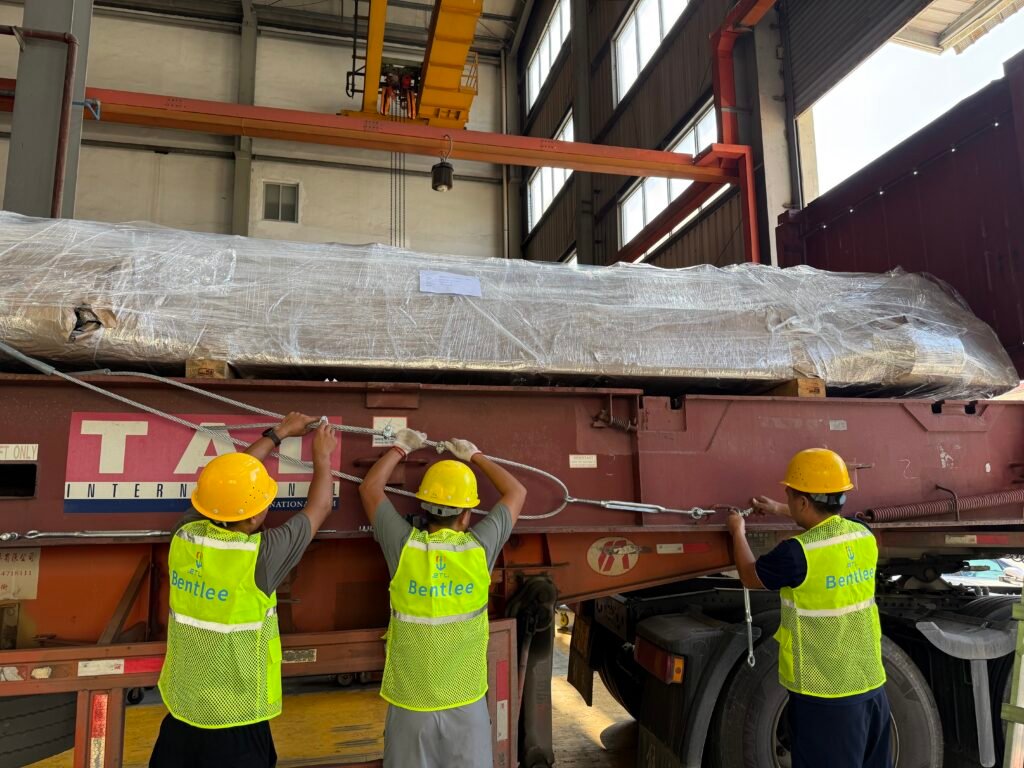
Why Cargo Shifting Occurs During Ocean Transport
Cargo transfer in the sea is not spontaneous but rather regular with trends that have been motivated by the continuous movement of the vessel, but not individual extreme occurrences.
An ocean voyage, in contrast to road or rail transport, exposes cargo to cyclic acceleration in more than one axis. The greatest lateral forces are generated by rolling (side to side); the longitudinal forces are generated by pitching (fore-aft); vertical surges are generated by heave, and low-regular cycles caused by continuous engine/hull vibration eventually wear out lashings.
These effects are revealed by long at-sea journeys. A securing that remains firm in less than 48 hours can indicate noticeable slack in 1012 days, in particular, on transpacific or transatlantic services. The longer the transit, the more important it is to come up with restraints that can withstand not only peak loads, but also repeated sub-peak cycles.
Common Causes of Cargo Shifting at Sea
The majority of the cargo shifting incidents can be divided into a few recurring categories, and almost all may be helped by the same underlying defects in restraint planning, as opposed to the weather only.
| Cause | Description | Resulting Risk |
| Insufficient lateral restraint | Cargo not adequately restrained sideways, often relying only on weight or dunnage | Progressive sliding toward one side |
| Incorrect lashing angles | Force not aligned with expected movement direction (e.g., lashings too vertical for rolling) | Reduced holding power, early tension loss |
| Poor friction interface | Smooth contact surfaces between cargo base and deck/container floor | Micro-movement initiates even under moderate forces |
| Load settling / Packing compression over time | Cargo or dunnage compresses during early voyage, creating slack | Lashings lose pre-tension gradually |
The patterns are consistent within post-voyage survey, seldom does a single rogue wave seem to be the cause of the problem.
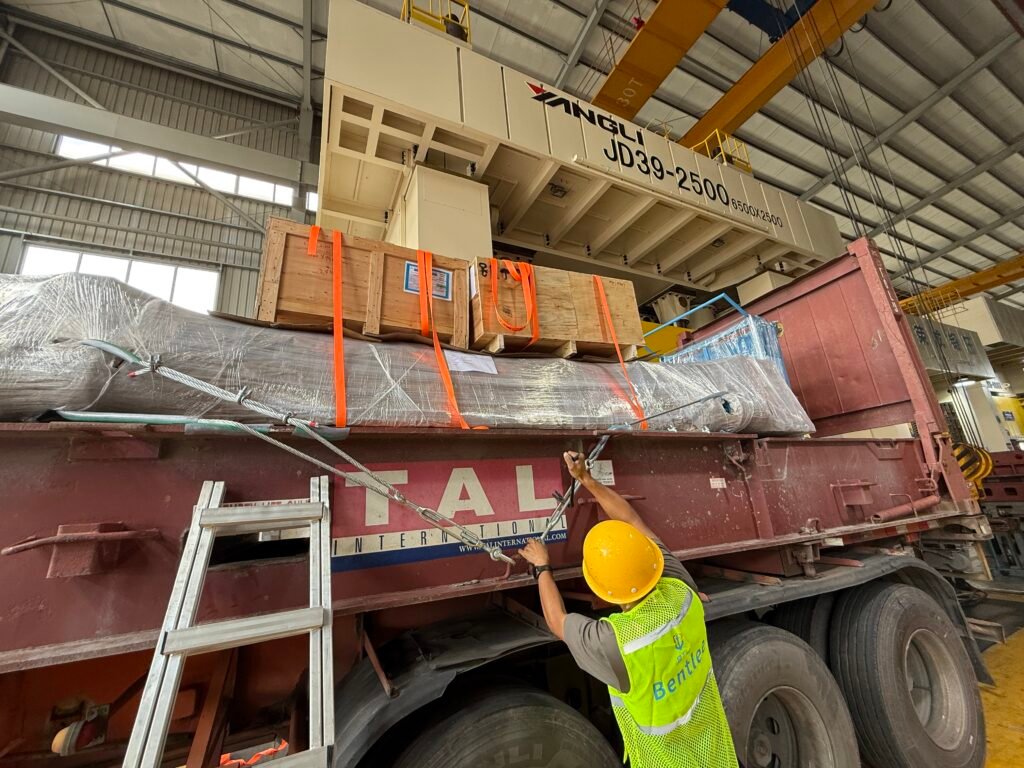
Why Static Weight Assumptions Fail in Ocean Transport
Use of the mere weight is not a sufficient measure in generating the illusion of safety in a cargo movement plan in the ocean transport.
At the port berth, cargo seems to be attached since gravity prevails. At sea, everything is different with dynamic loads.
| Assumption | Static View | Ocean Reality |
| Weight | Constant downward force | Directional and cyclic (lateral, fore-aft, vertical) |
| Position | Fixed once placed | Gradually changing due to micro-movements |
| Securing tension | Stable after tightening | Decreasing over time from vibration and settling |
The exact reason why heavy cargo shifting risk rises is due to the fact that the weight is all that aids in countering the lateral accelerations which happen to be much greater than friction coefficients of typical surfaces (steel-on-steel =0.1-0.2 without improvement).
How Small Movements Escalate Into Major Shifting
Even minute initial movement is magnified to severe movement unless prevented early in life.
At the moment of a temporary overcoming of friction there are usually micro-movements of merely millimeters per cycle. Contacts are abraded in each movement, and friction is further reduced, and lashings are loosened in small steps. After many thousands of roll/pitch movements (50,000–100,000 oscillations at sea in a week) slack is built up until lashings do not distribute the loads equally any longer.
The damage often takes too long to manifest itself, until late in the voyage; initially, early motion is REAL, but once gaps have reached 50-100 mm forces are focused on the remaining restraints, and fails one-liners occur causing the situation to blow out of control.
Preventive Measures That Reduce Cargo Shifting Risk
To avoid cargo movement during ocean transportation, there has to be decisions made prior to loading occurring, system-level design securing is always better than fixing the problem at the last moment.
Key elements include:
- Designing early securing – Model Predicated accelerations by route, vessel type and season instead of using assumed ideal conditions.
- Positioning of the load and balance of restraints – This involves positioning the heavy objects in ways that bring down the center of gravity and evenly spread the forces, the heavy items should not be placed in the way that will increase the rolling torque; this is known as eccentric loading.
- Management of friction and anti-slip control measures -Use high friction mats, rubber pads, or non skid surfaces; do not suppose critical restraint on bare steel to bare steel.
- Redundancy in securing systems – Multiple load paths independent Keys Multiple independent load paths (e.g. direct lashings, block, and bracing) so that failure of one will not cause a failure of the whole.
These principles are principles that cannot be compromised when it concerns a project cargo or oversized cargo.
The Role of Professional Securing Planning in Ocean Transport
Engineered securing plans always show better results than ad-hoc techniques since they consider restraint as a balanced system in line with the real sea behavior.
Planning Professional planning begins with route specific force calculations, load modeling in 3D, and the interaction of lashings when subjected to a combination of motions. It takes into consideration long-sea-voyage realities which are settling, vibration fatigue and progressive tension loss which are not taken into consideration by generic guidelines.
Systematic methods assure that all of the parts (friction, direct restraint, blocking) complement each other, as opposed to the disjointed whole. System level securing is important to shippers carrying heavy or high value cargo due to long sea routes during which an error in design multiplies over distance and time. In cases of uncertainty with complex loads cargo securing services to validate plans against real-world dynamics.
Practical Checklist for Reducing Cargo Shifting at Sea
The result of this is reduced shifting risk through a series of actions during the planning process and implementation process that are verifiable.
| Area | Preventive Action |
| Load positioning | Optimize center of gravity; avoid off-center stacking |
| Lashing system | Balance directions (lateral, longitudinal, vertical) with redundancy |
| Friction control | Use anti-slip materials under all contact points |
| Inspection | Recheck tension and arrangement immediately before vessel departure |
| Voyage duration | Adjust securing intensity (extra lashings, tighter angles) for long transits |
Checklist- Check during pre-shipment surveys, it is the difference between good arrival and a claim file.
Conclusion — Cargo Shifting Is a Preventable Securing Failure
Transporting cargo over the ocean is not a risk that cannot be avoided. Mostly, it is caused by the failure to capture the decisions which take into consideration the unrelenting movement and the accruing force during the voyage.
Its avoidance can start with the realization that cargo does not act in the sea as it wants in stationary storage, being exposed to cyclic, multi-directional stresses that deteriorate inadequate securing means during service, and then to institute an orderly, systematic logic of securing in the initial installation. When the design is based on reality rather than constant conditions, the risk is of the order of zero. Adequate planning enables what might have been a ship a long distance menace to be a controlled minor issue.