
The majority of destruction involved in Flat Rack deliveries is not accidental but happens to be the direct consequence of bad lashing choices made either in the planning or in the execution. Based on the decades of experience with incident reports to which I add loading supervisions and analysis of returned damaged units, a single pattern is obvious flat rack lashing damage is almost always related to the application of inadequate securing measures, not the motion of the vessel, risk on the road, and unforeseen weather conditions.
The flat rack containers are different to the conventional dry boxes. The cargo is completely exposed upon a framework of but skeleton, the lashing points being concentrated on the corner castings at the floor level and only other fittings limited to a few higher ones. Because of its large capacity to accommodate oversized or awkward loads such as heavy machinery, coils of steel or modules of the project it offers great flexibility, but its capacity also increases eventual flat rack securing errors. Even a minor angular error, or lack of lateral restraints that would be acceptable within a closed container would be disastrous here as there is no natural side support to hold against movement.
One of the myths planners and site teams like to use is: “Having dropped the cargo, it cannot move, because it is heavy enough to move it. Reality shows the opposite. The static weight does not provide any protection against the dynamic forces- the lateral acceleration in rolling the vessel, braking of a truck in the highways or even the low frequency vibration in long distances. Such improperly lashed flat rack constructions collapse exactly due to the underestimation of these forces, and the minute movements build up to be noticeable and irrevertible.
The main issue causing harm of the Flat Rack shipments is improper lashing since exposed cargo increases the risk of any minor securing errors during shipping.
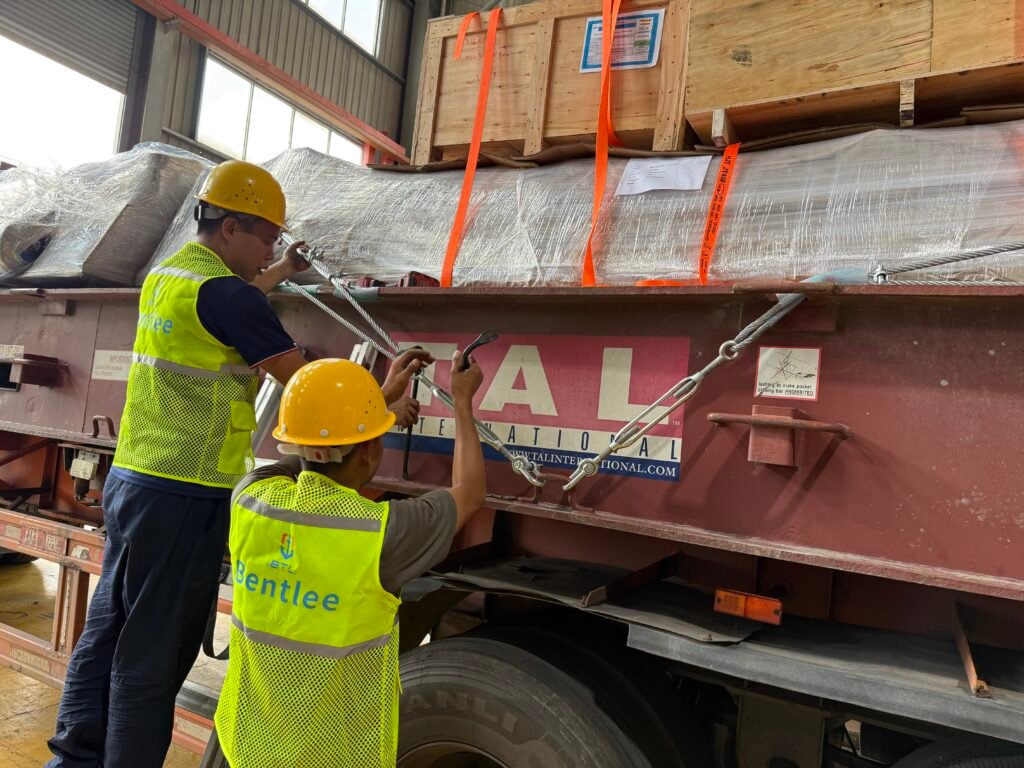
Why Flat Rack Shipments Are More Vulnerable to Lashing Errors
The geometry and open-structure of the flat racks make them more susceptible to flat rack securing errors in comparison to the regular containers.
The load is completely wrapped in standard containers whereby the forces are distributed over six hard sides thus offering natural blocking protection against lateral movement. Flat Racks, on the contrary, depend altogether on external lashing to withstand in every other direction, but downwards gravity. Missing side walls imply that there will be no passive resistance to side-sway; the cargo area has no roof, and is susceptible to direct loading by the wind (which can be very substantial at sea level); and there will be few restraint points, namely floor D-rings and few upper turnbuckle locations.
This limited restraint geometry focuses the forces on fewer locations, which transforms small lashing disequilibriums into localized high stresses. Dynamic inputs Roll, Pitch, heave at sea or longitudinal surge on trailers influence the cargo directly without any buffering envelop. Wind is the only one that can provide an uplift or side force that containers that are of the norm do not have at all. Add to it a vibration due to road or rail and even well-intended lashings, carefully thought out and badly calculated, soon permit movement.
Common Flat Rack Lashing Errors That Lead to Cargo Damage
The vast majority of the flat rack cargo conducts damage based on the error patterns that can only be repeatable across several hundreds of project deliveries.
The errors encompassed by these causes are usually not so much the failure of the lashing material itself, but rather improper application or improper planning or disregard of cargo-specific geometry.
| Lashing Error | What Happens | Damage Outcome |
| Insufficient lateral restraint | Cargo shifts sideways under roll or turn | Frame deformation, bent base |
| Incorrect lashing angles | Uneven force distribution | Localized stress damage, cracking |
| Over-reliance on vertical tie-downs | Poor horizontal control | Sliding during braking/acceleration |
| Missing edge protection | Chain-to-surface contact | Abrasion and surface damage |
These mistakes can be observed in all damage surveys. The commonest is the underestimation of lateral requirements lateral requirements are not given much thought by the planners; instead, the planners uphold downward hold-down and do not pay much attention to cross-lashings holding sideways movement.
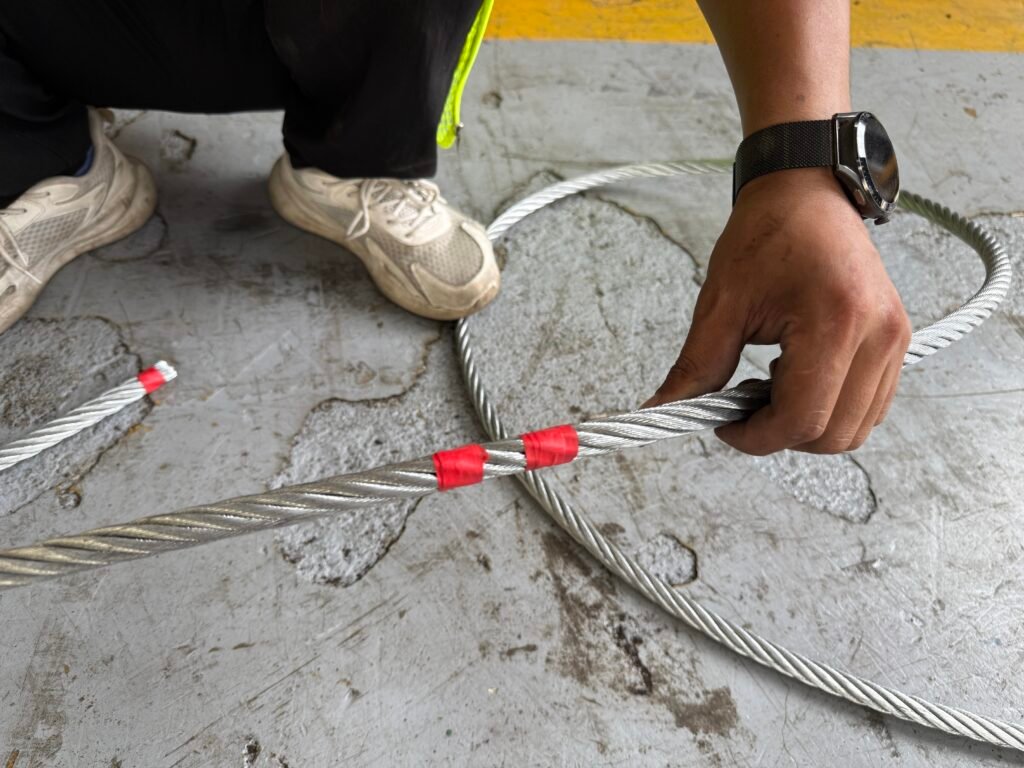
How Load Movement Escalates Into Structural Damage
Immediately the initial movement starts, the damage itself grows out of proportions since Flat Rack cargo does not possess any kind of an enclosure that could absorb or redistribute the energy.
Micro-movements Micro-movements can be in the range of millimeters per cycle, and they begin at the start of the transit. These repeated maneuvers establish fatigue at the points of attachment, at points of fretting and a certain amount of loosening in the lashings, in the course of hours or days. The initial external indication may be a small tilt which you notice during transshipment, but during arrival, the resultant cumulative action has already resulted in crooked frames or broken seams of the welds.
Why is there more damage caused after the initial motion? Since the loosened lashings no longer have the fine tension, the amplitude of later cycles is permitted to increase. A cargo unit which begins with 5 mm play may conclude with 50 mm and above and becomes controlled restraint.
Misunderstanding Static Weight vs Transport Forces
It is a common belief in many teams that heavy cargo does not move simply because it is heavy but indeed the weight at rest does not have much correlation with the actual forces involved in a transport.
| Factor | Static Assumption | Real Transport Condition |
| Weight | Constant downward force | Directional force (lateral, longitudinal) |
| Contact | Fixed and stable | Repeated micro-shift and vibration |
| Stress | Evenly distributed | Concentrated at lashing points |
Forward force of braking on a truck can be as high as 0.8g or even higher; lateral vessel rolling in moderate seas can easily be greater than 0.3g. The amplification of the forces exerted on flat racks is greater as the sidewalls do not damp, all inputs are nearly passed to the securing system.
Why Generic Securing Methods Fail on Flat Racks
Ways that prove to be dependable in conventional containers often do not work on Flat Racks since the restraint reason is totally distinct.
Lashings in a closed box generally act as supplements to the container. Lashings On a Flat Rack the structure on lateral and longitudinal control is by lashings. Down only tie-downs disregard the requirement of cross-lashings to make a force triangle. The system does not withstand mixed forces without geometric-local design – that is, consideration of cargo footprint, center of gravity height, and lashing points available to the system.
Design is a key aspect that should be done early: when someone is taking measurements on-site and doing 3D planning, not at the day before delivery on the quayside.
How Proper Lashing Design Reduces Flat Rack Damage Risk
The one most effective control in the prevention of the risk of flat rack shipment is proper lashing design.
The initial planning has to coordinate the placement of loads, the lashing angles, and ties. The angles that maximize the horizontal components with enough vertical hold-down are optimal angles (45 60 degrees is typical with cross-lashings). Cargo logic, which takes into consideration shape, distribution of weight, and contact surfaces, allows the distribution of forces evenly instead of concentrated.
The order of lessons to be followed when it comes to guiding this process is outlined in the detailed overview of flat rack cargo lashing and securing.
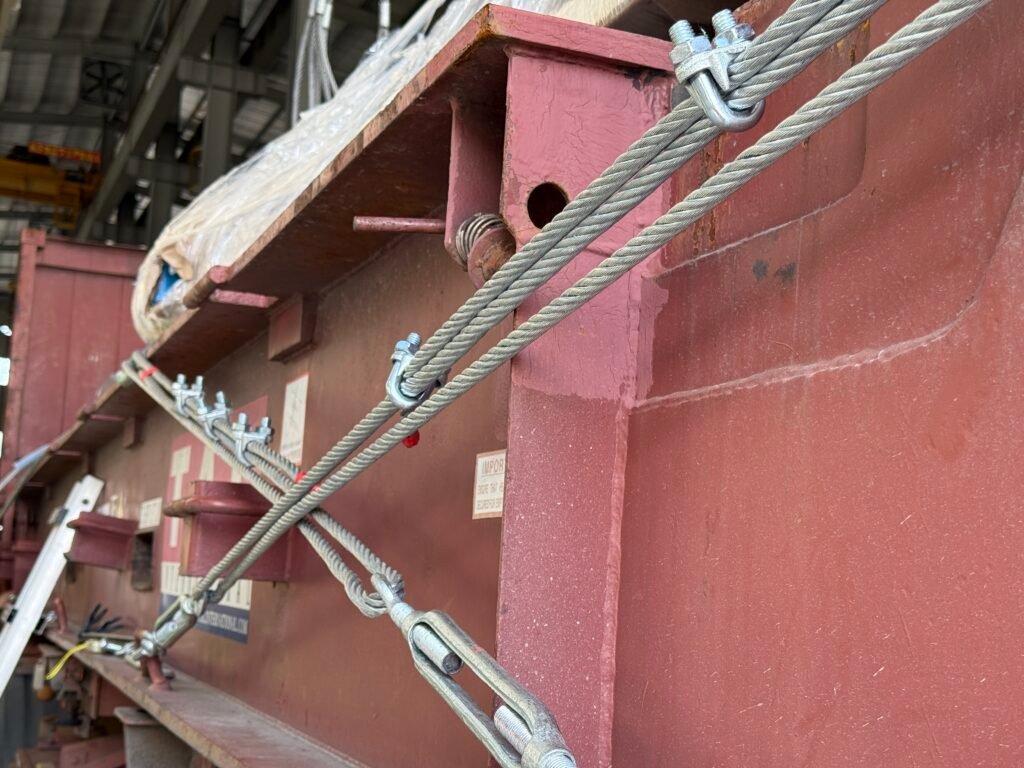
Typical Damage Patterns Seen in Improperly Lashed Flat Rack Cargo
Lashings that permit movement result in predictable patterns of the resultant flat rack cargo damage.
| Damage Pattern | Root Lashing Cause |
| Bent frames | Poor lateral restraint |
| Cracked mounting points | Uneven tension |
| Surface abrasion | Missing protection |
| Internal stress cracks | Progressive movement |
These are not idiopathic failures they trace directly to the deficiencies in securing mentioned above. Bent frames virtually signify the lack of cross-lashings or the existence of small abrasion marks, which signify the lack of corner protectors or direct contact with chains.
Conclusion — Flat Rack Cargo Damage Is a Securing Problem
Shipment of Flat Rack does not fail at random. In case something is broken, it is often possible to trace it to the inappropriate choices of the lashing technique which enabled movement, concentration of stress, or uncontrolled transfer of forces.
The key to damage prevention is to first learn the behavior of Flat Rack cargo when subjected to real transport dynamics- and then protect it in a way that is not based on general assumptions but on geometry.