
What is OOG cargo? This practical guide explains the OOG cargo meaning, out-of-gauge dimensions, container options like flat racks and open tops, costs, risks, and tips for importers handling oversized freight from China or elsewhere.
Introduction
Right off the bat, what is OOG cargo? It’s shorthand for “out of gauge” cargo—basically, any shipment that’s too big, too wide, too tall, or too heavy to fit snugly into a standard shipping container without modifications or special handling. As a logistics specialist with over a decade in OOG logistics at Bentlee, I’ve managed hundreds of these projects, and I can tell you: if you’re an importer dealing with heavy machinery cargo or irregular industrial parts, overlooking OOG specifics can turn a straightforward import into a nightmare of delays and extra costs.
Importers often run into oversized cargo when sourcing from manufacturing hubs like China—think massive presses, assembly lines, or construction modules that don’t play nice with regular boxes. These shipments require specialized OOG logistics because standard methods just won’t cut it; you need tailored planning to avoid damage, comply with regulations, and keep budgets in check. Why? Because OOG shipping from China or anywhere involves extra surcharges, custom securing, and route tweaks that standard freight skips.
In a nutshell, OOG logistics works like this: Start with precise measurements, choose the right container or method (like flat rack or open top), secure everything per international standards, book space with carriers who handle out of gauge cargo, and monitor from factory to destination. Getting this right early saves headaches—let’s break it down further.
What Exactly Is OOG (Out-of-Gauge) Cargo?
Diving deeper, the OOG cargo meaning boils down to freight that exceeds the internal dimensions or weight limits of a standard container, forcing you to use alternatives. It’s not just about size; shape matters too—if your cargo has awkward protrusions or an uneven base, it’s OOG.
Real-world examples abound in my line of work: heavy machinery cargo like CNC lathes or injection molders that tower over 3 meters, steel structures for bridges that span too wide, modular factory lines disassembled into bulky sections, or industrial parts like turbines with irregular flanges. At Bentlee, we’ve handled everything from wind farm blades to oil rig components—anything that screams “oversized freight.”
Cargo is considered out-of-gauge when it surpasses standard limits: typically, over 2.35 meters wide, 2.59 meters high, or 12 meters long for a 40-foot container, or weighs more than 25-30 tons. Even if it’s close, carriers classify it as OOG to account for safe loading and transit risks. Understanding this upfront helps importers budget for the inevitable OOG surcharge and plan accordingly.
When Cargo Becomes OOG (Dimension Standards Explained)
Let’s get specific on those out of gauge dimensions. Standard containers come in a few flavors: A 20GP (general purpose) is about 5.9 meters long, 2.35 meters wide, and 2.39 meters high inside. Bump to a 40GP, and length doubles to 12 meters with similar width/height. The 40HQ adds height to 2.69 meters for taller loads.
Cargo turns OOG with over-height (anything poking above the roof line), over-width (bulging past the sides), or over-length (hanging off the ends). Why even small exceedances like 2-5 cm matter? Carriers enforce strict rules for stacking on ships and port equipment limits—those inches could mean rejection or forced repacking.
Common culprits include profiles like wide-base excavators, tall silos, or long pipes. In OOG shipping from China, I’ve seen importers surprised when a machine’s control panel adds just enough width to trigger OOG status. Always measure fully assembled (or disassembled if needed) to catch these early.
OOG Shipping Methods & Container Options
Once identified as OOG, you pick a method. Here’s what works based on my hands-on experience.
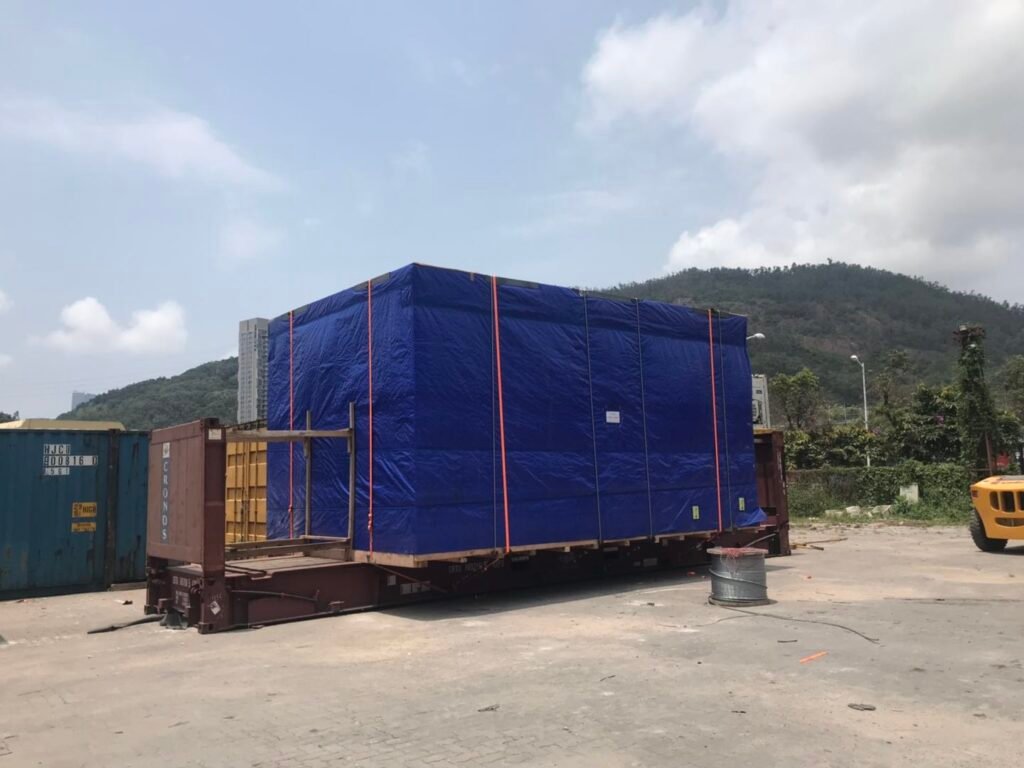
- Flat Rack Containers These are platforms without roofs or fixed sides—collapsible ends let you load wide or heavy items. Ideal for flat rack OOG shipment of things like transformers or conveyor belts. Choose this when width is the issue; it allows overhangs with secure lashing. I’ve used them for oversized equipment shipping where side access prevents damage during loading.
- Open Top Containers Rigid walls but a removable top for crane drops—perfect for open top OOG shipment of tall cargo like vertical presses. The vertical loading keeps fragile parts upright. Great if height’s the problem but width fits; add a tarp for weather protection.
- Breakbulk Shipping For breakbulk OOG cargo that’s way too big, like 100-ton generators, this loads directly onto the ship’s deck. No container limits, but expect higher costs and exposure. Useful for extremely oversized freight in engineering logistics projects.
- RO-RO Shipping Roll-on/roll-off for wheeled units, like tractors on trailers. Drive them aboard—no cranes needed. Suited for mobile heavy machinery cargo, reducing handling risks.
For instance, in a factory relocation from Shenzhen, we mixed flat racks for wide parts and open tops for tall ones—tailoring saves time and money.
How OOG Cargo Is Handled: Engineering & Safety Requirements
Handling OOG isn’t guesswork—it’s engineering. At Bentlee, we start with on-site cargo measurement using laser tools for pinpoint accuracy, identifying lifting points to avoid stress fractures.
Center of gravity distribution is key; miscalculate, and your load tips. We use 3D load plans and stowage simulations to visualize ship motion and optimize balance. Lashing and securing follows CTU Code—chains, straps, and blocks rated for forces up to 5G.
Reinforcements like wooden crates or steel frames protect edges; for moisture-prone machinery, vacuum sealing or desiccants prevent rust. Port restrictions demand carrier approvals early—some terminals cap crane lifts at 50 tons. We’ve averted disasters by simulating stowage for a 40-ton module, adjusting lashing to comply.
OOG Surcharges & Cost Factors
Costs stack up quick. Base ocean freight might be $3,000 for a 40-foot from China to the US, but OOG surcharge adds 20-50% for over-dimensions—$500+ per exceedance.
Lashing and securing runs $300-1,000; trucking with special trailers (lowbeds for height) hits $1,000-5,000. Crane/rigging fees at ports: $500-2,000 per lift. Terminal handling charges inflate for OOG, plus documentary costs like plans ($200-500).
Factors like route (congestion in Panama Canal) or peak season bump totals. In one Bentlee project, optimizing a flat rack load cut surcharges by 15% through better packing.
Common Risks & How to Avoid Them
Risks lurk everywhere. Incorrect dimensions? Carriers reject at loading—avoid by double-checking post-packing.
Poor lashing leads to shifts and damage; prevent with certified teams and CTU compliance.
Missing paperwork, like lashing plans, halts customs—prepare early.
Route mistakes, like low bridges, strand trucks; map with pros.
Unsafe trucking? Fines or accidents—use permitted haulers.
Moisture damage to machinery? Use seals and crates.
Tips: Insure comprehensively, monitor weather, and partner with experienced firms like Bentlee for risk audits.
A Step-By-Step Process: How OOG Cargo Is Shipped
Here’s the workflow I follow:
- On-site survey: Visit factory, assess cargo.
- Cargo measuring: Confirm dimensions, weight, COG.
- Engineering evaluation: Create 3D plans, select method.
- Container / method selection: Match to cargo profile.
- Lashing & protection: Secure, crate, seal.
- Port handling: Load with cranes, clear export.
- Customs & documentation: HS codes, declarations, plans.
- Ocean shipping: Track en route.
- Destination handling: Unload, deliver.
This keeps things smooth—skipping steps invites chaos.
When Importers Should Consider OOG Logistics
Turn to OOG for importing heavy machinery like excavators, factory relocations with full lines, or industrial equipment like boilers.
It’s essential for infrastructure components (beams, pipes), renewable energy gear (solar frames), construction modules, or custom machinery.
OOG reduces risks by customizing—fewer damages, faster clearances. In Bentlee’s experience, it cuts delays by 30% for complex loads.
Conclusion
In essence, OOG cargo is oversized freight demanding specialized care to ship safely. Key factors: accurate measurements, right methods, solid securing, and cost awareness. As importers, prioritizing these minimizes pitfalls. For reliability, team up with seasoned OOG logistics providers like Bentlee—we handle the details so you focus on business. It’s about turning challenges into seamless deliveries.