
Open Top Container Lashing and Securing Guidelines
The accelerating forces in cargo at sea include large vessel motions such as pitching, rolling, surging and heaving which is usually increased during heavy weather conditions. In open containers where the cargo all the time sticks out above the top rails, improper lashing is known to cause cargo shift, excessive stress on the container, possible structural failure or is simply refused by the carrier or the port in the survey.
There is still a common misperception that all you need to make certain of a securement is ensuring there are more straps or chains. Practically, good open top container lashing requires a designed restraint system to preanticipate and counteract all dynamic transport forces in all directions, not just one kettle of haste warehouse redress.
OOG shipments that are complex will involve, open top cargo securing and transportation skills, so as to help in calculating forces and restraints properly in advance prior to shipment.
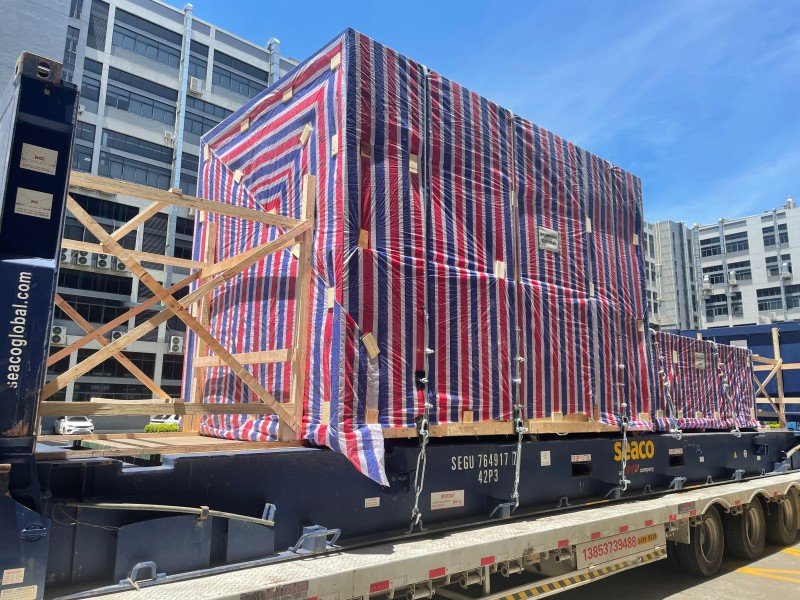
Understanding Transport Forces in Open Top Shipping
The full range of dynamic forces met in the sea must be addressed by open top container lashing because the motions in the vessels cause acceleration that is many times greater than on other transport modes on land and by rail.
The primary forces include:
- Forward force: This force occurs as a result of deceleration of vessels (braking) or head seas pitching, which drives cargo into the container front.
- Backward force: This happens in acceleration or after the seas; the thrust being on the cargo towards the back.
- Lateral force: Initiated by rolling movements which in most cases are the most dangerous and can cause tipping particularly when there are high loads or asymmetrical loads.
- Vertical uplift: Uplift attempted by waves impacts or by heave, i.e. tries to raise cargo vertically: this can be disastrous where over-height OOG cargo is not covered by a roof.
Excessive height of cargo adds to the latitudinal instability since the high center of gravity will increase tipping moments during the roll motion.
| Force Direction | Risk to Cargo | Required Countermeasure |
| Forward | Sliding toward container front | Strong blocking + forward-directed lashing |
| Backward | Shift toward rear doors | Rear restraint blocking + backward lashing |
| Lateral | Tipping or side shift | Cross lashing + symmetrical side restraint |
| Vertical | Uplift or bouncing | Top-down tension lashing + secure base |
These forces are based on industry standards such as the IMO/ILO/UNECE CTU Code that insists on the computation of the accelerations, referring to the vessel parameters or stowage location and voyage conditions.
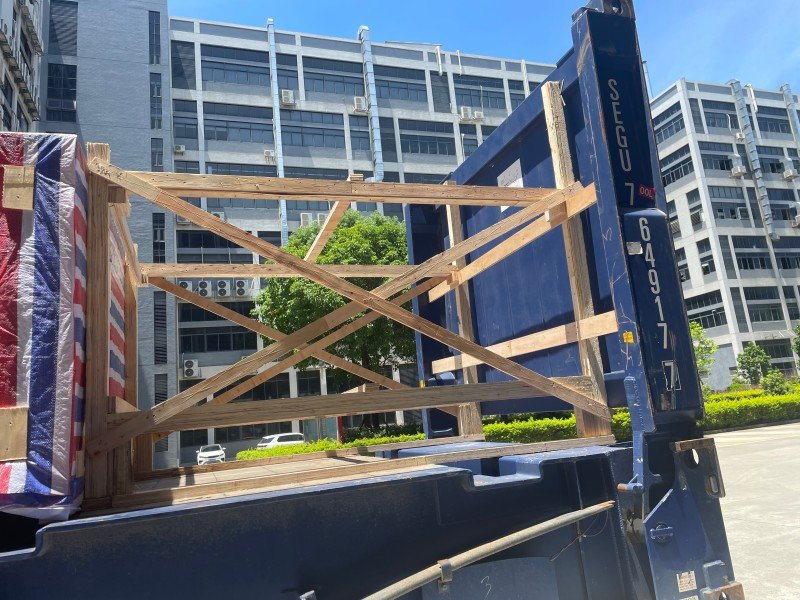
Blocking, Bracing, and Lashing: Key Differences
Lashing and securing in open top containers is successful when blocking, bracing and lashing are considered as complementary factors and not substitutes.
- Blocking– here they seal off the spaces with stiff materials (timber, steel frames), which stop the initial horizontal movement.
- Bracing offers structural support, shares weight and supports against deformation, particularly in high center of gravity objects.
- Lashing is an application of controlled tension through chains, wires or straps in order to resist dynamic forces, and ensure contact with each other even during movement.
These means are hardly ever used alone but most of the safe loadings are done by means of combination.
| Method | Purpose | Best Use Case |
| Timber Blocking | Prevent sliding | Heavy machinery on container floor |
| Steel Bracing | Structural reinforcement | High center-of-gravity or irregular cargo |
| Chain Lashing | Strong, rigid restraint | Very heavy equipment |
| Polyester Straps | Flexible, even tension distribution | Medium-weight, sensitive cargo |
Open top testing with blocking When there is no top available, the first shock can be absorbed with blocking, the shape should be maintained with bracing, and constant restraint secured with lashing, as always according to the recommendations of the CTU Code.
Lashing Angles and Tension Control
The right angles of lashing constitute the foundation of an efficient holding system; misalignment angles lower holding power by a wide margin.
Optimum lashing angles are 30 to 60degrees to the horizontal- between horizontal constraint (sliding) and vertical element (tipping/ uplift). Angles steeper than 30 o lose efficiency quickly, becoming nearly entirely friction based, whilst angles steeper than 60 o reveal insignificant horizontal resistance.
Tension in all lashings is evenly distributed, preventing the load distribution and occurrence of imbalance; tightening one side too much will lead to deformation of the container, or breaking the straps and chains.
Some typical error in rushed-loading are flimsy angles of elevated anchor points, or uneven releasing.
| Incorrect Practice | Consequence |
| Too shallow angle (<30°) | Reduced horizontal restraint |
| Uneven tension | Load imbalance, localized stress |
| Over-tightening | Structural stress on cargo/container |
| Insufficient anchor points | Cargo shift under moderate forces |
There is an always the verification of angles as a result of the pre-loading checks, as well as the adjustment of the points the anchor or the placing of cargo.
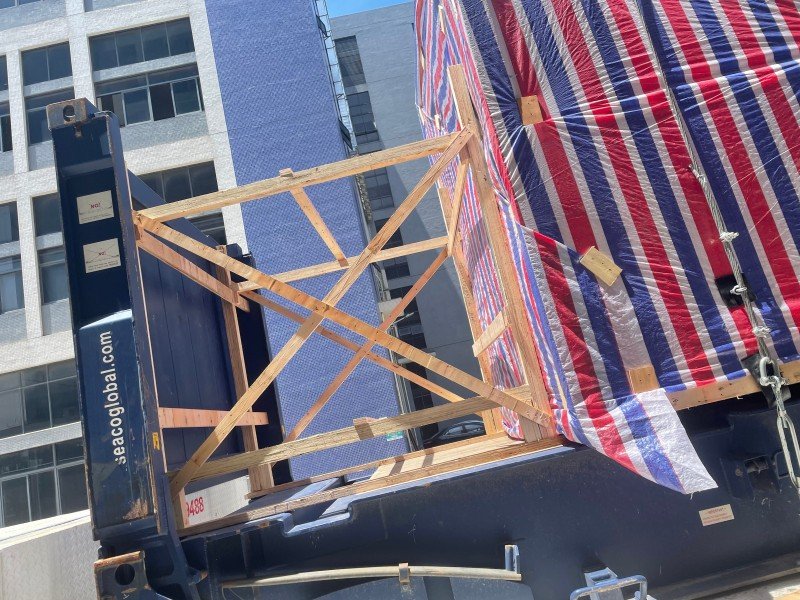
Center of Gravity and Stability Considerations
One of the major causes of instability during container shipments carried by open tops is a high or offset COG.
High COG raises the tipping leverage in lateral rolls whereas asymmetry leads to imbalance in the loading of the sides and risk of racking the containers.
As a best practice, reduction of COG should be achieved by the way of beam reinforcement of the base (timber dunnage, spreaders), distributing weight among beams of the floor, and fixing on both sides.
Stability Checklist
- COG identification Yes – Measure or compute vertical / horizontal position.
- Base width evaluation: Yes- Check wide foot print in regard to height.
- Verification floor load limit: Yes- Do not overload the containers.
- Sidewall stress check: Yes- Firm yes.
COG should not be ignored as it results in surveyor rejection or mid-voyage problems.
Securing Over-Height (OOG) Cargo in Open Top Containers
Over-height cargo, which sticks out beyond the rails on the containers, presents special difficulties in the securing of open tops.
Open areas experience direct wind pressure, more lateral pressure and tarpaulins experience minimum protection against weather with no structural support.
Counter uplift with reinforcement by further top lashing (cross or vertical) and side projections by extra side bracing. Height-adjustments are lashing points and tension frequencies.
Windage must be always taken into consideration in the computation of forces according to CTU rules.
Inspection and Compliance Before Dispatch
Last minute checks involve last minute oversights that would jeopardize the voyage.
Tension checks (tug checks) to be made, checking of blocking integrity, OOG markings placed in a clear manner and everything photographed to ensure insurance and carrier documentation.
Final Inspection Checklist
- Lashing tension test: Eliminate slackness in motion.
- Blocking integrity: Check no loopholes or movement.
- OOG labeling: Port compliance.
- Photo record: Insurance protection record.
- Carrier/surveyor checks: Approach prior to dispatch.
Failure to do so may result in the rejection or hold up of ports.
Common Lashing Failures and How to Prevent Them
In fact, real-life failures are frequently related to compromises based on a failure to take engineering principles into account.
- Lack of anchor points941 Inadequate force distribution1130 Shift.
- Poor choice chain/straps selection → Over-filling of MSL = Breakage.
- Vibration/settling Unnoticed, Slack forms, Loss of restraint.
- Excessive use of straps without blockingلعantry Sliding at low friction.
- No subsequent re-tensioning on already loaded upper abdomen methods helps to result in looseness.
The results can be cargo damage, container deformation, insurance claim or complete port rejection. To prevent, they should be planned, material checked, and verified after loading.
Conclusion — Securing Is an Engineering Discipline
Securing and lashing of open top containers is an engineering process that is organized to balance the forces, structural integrity, and regulatory requirements. Knowledge of transport forces, proper angles and techniques, and controlling the COG, as well as proper inspection prior to dispatch, contain cargo and vessel safety, and shipment reliability. Tackled in a systematic way instead of reactive one, it reduces risks of the OOG sea transport.