
When considering OOG transport of heavy equipment, such as excavators, turbines, or press frames, the choice of container is not only dependent on size or on the availability of it. It dictates right in the securing strategy. Flat Rack and Open Top containers are similar, at first sight, being both meant to transport oversized cargo unable to fit in regular boxes, but differ in the most basic aspects when it comes to regulating cargo flow.
A large number of teams believe that because the equipment fits, the method of securing is more or less had by chance. Practically, that is one of the most expensive project cargo misperceptions. Flat Rack types of containers provide virtually no restraint other than that of the base and end walls and are thus constrained to using active lashing geometry. The top container is the Open Top container which offers partial containment with the side walls ensuring a different management of the forces.
Flat Rack and Open Top containers are both used in the oversized cargo, but since this type of cargo is vulnerable in exposed areas, the structural limitations also make the difference in securing methods. Making it wrong will result in loads being shifted, torn gear or, more seriously, claims being incurred which might have been avoided had planning taken place at the containers level.
To take a closer look at the system-level solutions to restraint, see our guide on securing methods for OOG cargo.
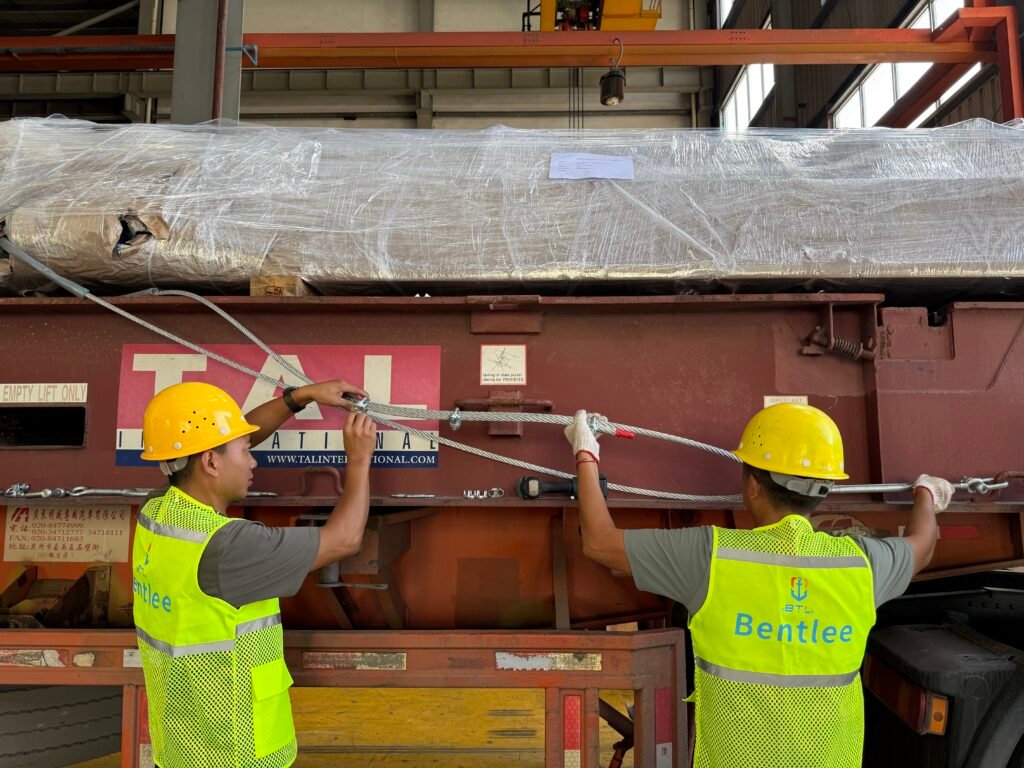
Structural Differences Between Flat Rack and Open Top Containers
The main dissimilarity begins with the skeleton of the container.
The Flat Racks do not contain any side walls, fixed roof, but only a substantial floor platform with foldable or permanent end walls (usually removable return legs). Instead, restraint is nearly completely limited to outside lashings to floor D-rings, corner castings and even the end frames.
Open Tops have their side walls as high as possible, but the roof is marked by a tarpaulin roof (and sometimes none at all). The side walls serve as passive resistant elements to lateral motion whilst the vertical control may be by integrating lashings with the tarpaulin tension.
It is these structural realities that determine all of the geometry of load restraint.
| Feature | Flat Rack | Open Top |
| Side walls | None | Present (full height) |
| Roof | None | Flexible tarpaulin (or open) |
| Primary restraint | Lashing system | Combined walls + lashing |
| Exposure | High (fully exposed sides/top) | Moderate (sides protected, top variable) |
How Container Structure Influences Securing Logic
There is nothing when it comes to the securing of Flat Racks except that which is pure active restraint engineering. Since there are no side walls, all lateral and longitudinal forces will have to be opposed by lashing angles, pretension and increase in friction. The pattern of lashing must form counter-acting force vectors resisting the roll, pitch, and yaw motions at sea, road and rail movements.
Open Top logic is hybrid. The lateral containment is inherent in the side walls which does not tend to side-to-side shift under the heave or roll obviating (but not entirely removing) reliance on lashings to contain the horizontal movement. Vertical restraint is also to be observed, especially when tarpaulin is adopted, since the uplift of the wind, or pressure exerted by the stack, has no predictable interaction.
This misunderstanding of this difference between hybrid and pure-active is why so many loads shift. The number of lashing is the same between them, and the pattern is not considered, which disregards the fact that Open Top walls already absorb a section of the lateral distinct load path.
Securing Methods Commonly Used on Flat Rack Containers
On Flat Racks, zero passive side restraint will have to be compensated by the securing. The objective is to ensure that the cargo is locked to the floor in every direction by geometry and friction.
Diagonal (cross) lashings are the most commonly used since this offers the best balance of that lateral and longitudinal holding and dimensional reduced tipping risk. Angles: the angle best is 4560 to keep the best distribution of forces: a steeper angle results in holding the mechanism too firm and too straddling weakly; a shallower angle results in control when it is too broad and loses its grip.
Heavy equipment must not be used without blocking and bracing to ensure that it does not start sliding before the lashings are completely hooked up. The bottom of the base is supported with anti-slip mats or rubber pads, which boost the coefficient of friction, and in many cases, marginal lashings are transformed into dependable ones.
| Securing Element | Purpose | Risk if Incorrect |
| Diagonal lashing | Lateral restraint | Side movement / tipping |
| Blocking/bracing | Prevent sliding | Progressive shift during transit |
| Anti-slip mats | Increase friction | Micro-movement leading to fatigue |
Securing Methods Commonly Used on Open Top Containers
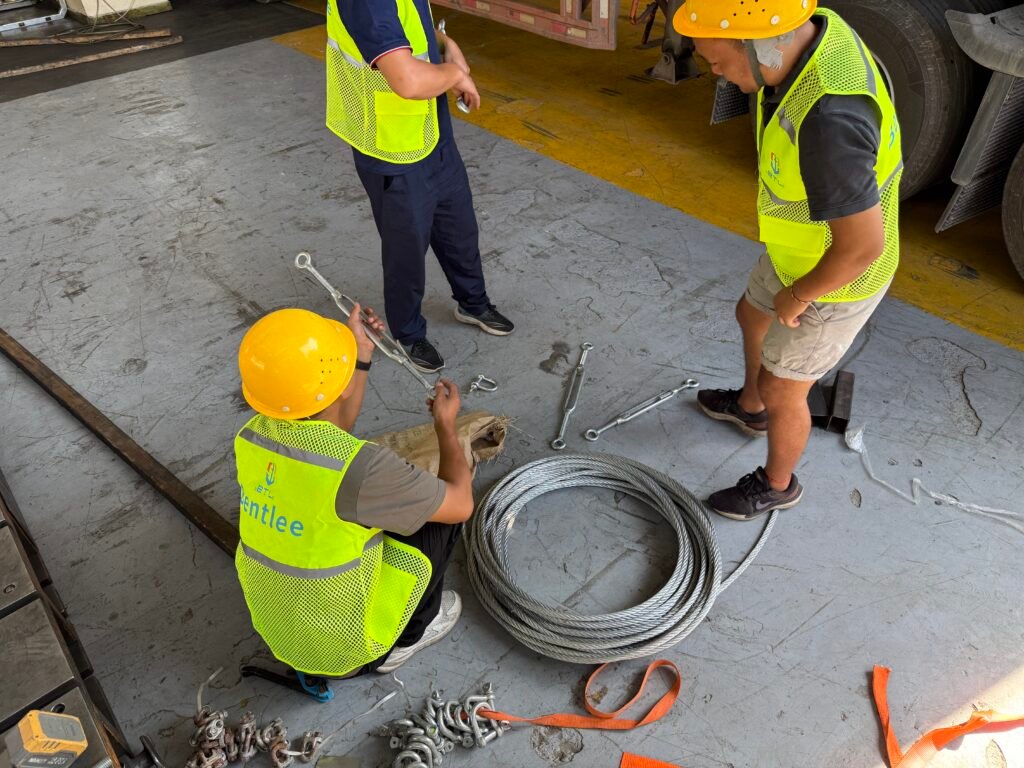
With the lateral containment of open Tops, a partial dependency on lateral side walls is permitted, and therefore, lashings are put more on vertical support and avoiding vertical uplift or overhang movement.
Side walls act as a natural guide and a buffer, when they are not structural restraint in their engineering meaning where excessive force can cause it to bow. Top-over lashings or vertical chains aid in the suppression of bounce and the pressing of the load as well as floor anchoring is essential regarding stability of the base.
Tarpaulin interaction is extra processes: excess tightness results in pressure points; insufficient tightness permits movement of the tarpaulin and releases the pieces of lashings after some time.
| Securing Element | Function | Limitation |
| Side walls | Containment | Not structural restraint |
| Top lashings | Vertical control | Limited lateral effect |
| Floor anchoring | Base stability | Depends on load position |
Why Applying the Same Securing Method to Both Containers Fails
The commonest field error is to copy a Flat Rack lashing plan to an Open Top (or the reverse). The lines on the forces are shifted radically.
On a Flat Rack lashings must be able to take the full acceleration due of every newton in a lateral direction. The same lashings on an Open Top might appearance adequate, but the walls already carry some of the weight-the over-lashing of the walls will resultingly cause an unexpressed distribution of stress and eventual deformation of the walls. On the other hand, insubordinating an Open Top due to the idea that the walls will give you a hand can easily result in the lack of vertical movement being checked.
The outcome: the number of lashings does not produce the same level of safety. One type of container can put up with marginal execution; the other lets down on it.
Choosing the Right Securing Strategy Based on Container Type
The inherent restraint profile in the container should be the foundation of the strategy that must also be secured. The plans at Flat Rack focus on efficiency in lashing and friction improvement. The open top plans use the walls to provide lateral stability with reinforcement of the vertical and dynamic controls.
The earlier design of the containering selection – at route survey stage, or load simulations in 3D – enables the crew to manage securing logic with realistic transit forces (roll, pitch, heave). This combined thinking reduces the risk of damages much more than some, last-minute decisions can do.
Typical Damage Scenarios Caused by Incorrect Securing Choice
Real-world claims tell the story clearly.
| Container Used | Incorrect Assumption | Resulting Damage |
| Flat Rack | Walls will restrain load | Lateral shift / cargo overboard |
| Open Top | Lashings alone are enough | Wall deformation / tarpaulin failure |
| Either | Vertical restraint only | Sliding during braking / acceleration |
These are not scholarly concepts, but they present themselves over and over again in the reports of surveyors when teams do not pay attention to container-specific behavior.
Conclusion — Container Choice Defines Securing Requirements
It is not that choosing Flat Rack and Open Top containers is simply a choice of loading types, but outlining the way in which cargo should be attached. Knowledge of how every container manages movement is important in the selection of the right securing system and avoiding unnecessary losses.
The lesson of decades of experience of shipping heavy equipment: restraint geometry must be considered a priority over container convenience. When the securing logic is conforming to the structure, the loading comes in undamaged, even during harsh conditions of the sea and the roads.