
Oversized cargo is freight in the international shipping that is larger than the standard size or weight requirements of the customary shipping containers. The importance of this classification is that such cargoes cannot be carried in regular containers but require special transport equipment such as flat rack containers, open top containers, breakbulk shipping or heavy haul transport equipment. Out-of-gauge (OOG) freight, the other term of oversized cargo, is to be evaluated carefully to come to the right conclusion about the handling practices and prevent any difficulties during the transportation.
One myth that has been created is that oversized cargo is merely large cargo but when it comes to the role of international logistics, there is a specific focus on items that exceed the structural limits of conventional shipping units. Cargo is oversized when it is too many dimensions or weight to be safely transported in the normal shipping containers and special equipment and logistical planning are necessary to transport the cargo safely. This knowledge is necessary to the logistics planners and freight forwarders to be able to estimate the risks, choose right containers and organize routes.
The essence of positioning in this case is simple: Oversized cargo describes the goods that either break the dimensional or weight requirements of the size of any typical shipping container and thus, demand specific transportation equipment and logistical arrangements. Professional OOG logistics services ensure these special requirements are handled safely from measurement to final delivery. Personally, when it comes to shipments of heavy equipment over international routes, my experience has made me aware of these thresholds at the very beginning to avoid delays, not to mention the fact that port regulations would be adhered to.
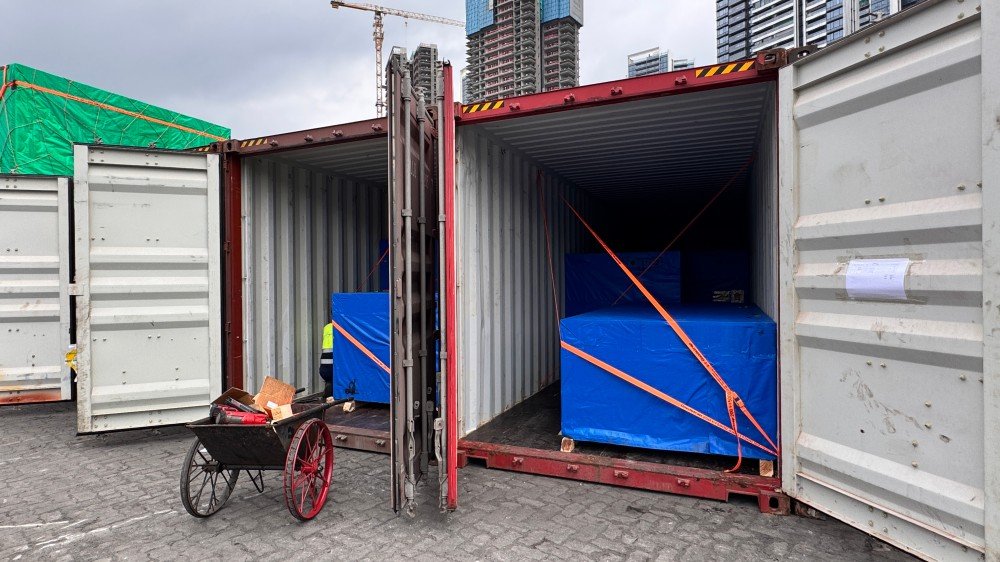
Standard Container Limits in International Shipping
The standard shipping containers form the point of reference when deciding what should be considered as oversized cargo in shipping since any cargo exceeding these dimensions falls under the special handling category. These are 20-foot or 40-foot containers whose internal dimensions and payload capacity predetermine how cargo may be loaded traditionally or whether different arrangements are required.
As an example, the following is a breakdown of the common standard container specifications:
| Container Type | Internal Length | Internal Width | Internal Height | Payload Capacity |
| 20-ft Container | ~5.9 m | ~2.35 m | ~2.39 m | ~28 tons |
| 40-ft Container | ~12 m | ~2.35 m | ~2.39 m | ~28 tons |
| 40-ft High Cube | ~12 m | ~2.35 m | ~2.69 m | ~28 tons |
Something larger than these limits is considered out-of-gauge (OOG) or over-sized and will require adjustments or even completely new modes of transportation. An example is that simple overheight means that the door cannot be closed anymore and the overweight may trigger the structural collapse during the lifting and the stacking of goods at the ports.
Dimension Criteria That Define Oversized Cargo
The definition of oversized cargo is characterized by certain dimension and weight factors which predetermine the inapplicability of the normal containerization and are usually accompanied by the increase in the logistics complexity. Such criteria assist in classifying freight and making decisions with regard to equipment and routing.
The most common methods of surpassing cargo limits are:
| Dimension Type | Oversized Condition |
| Height | Exceeds container roof height |
| Width | Wider than container interior |
| Length | Longer than container length |
| Weight | Exceeds payload limit |
Practically, large cargo usually demands unusual container orders to cater to such exaggerations. As an illustration, a machine that is excessively broad may stick out on the sides and therefore require a stronger mechanism to ensure stability whenever it is in the sea. Firms that deal with big industrial equipment normally use professional oversize cargo transportation to handle the choice of containers, route planning and securing of the cargo. This makes the definition of oversized freight to be in line with the practical transport requirements in the least ways possible, including avoiding risks such as damage by the shifting freight.
Common Examples of Oversized Cargo
Some types of cargo are habitually oversized because of their size or weight, especially within industries of heavy machinery or structural elements. These instances point out that the every-day industrial objects may exceed the usual boundaries, necessitating customized oversized cargo transport.
The most common overweight cargos are:
| Cargo Type | Typical Industry | Oversized Reason |
| Excavators | Construction | Excess weight and width |
| Wind turbine blades | Renewable energy | Extreme length |
| Industrial presses | Manufacturing | Heavy machinery |
| Power transformers | Energy | Large dimensions |
| Steel structures | Infrastructure | Oversized shape |
These products require a dedicated coordination since the dimensions of these products make loading and unloading difficult. In the case of wind turbine blades that may have a length of more than 50 meters the transportation may require stretching beyond the ends of the containers, exposing the sections to the weather and the use of protective measures.

Container Types Used for Oversized Cargo
When the usual containers are not adequate, special type will be necessary to carry oversized freights in a safe manner, with each having a particular dimensional difficulty. One of the initial processes in over-sized cargo transportation is to choose the appropriate one to offset the cost-safety-efficiency factors.
Major container options of oversized freight are: … Open Top Container — Tall cargo that can be loaded from the top. Our open top container shipping services provide reliable solutions for height-exceeding cargoes while maintaining proper protection:
| Container Type | Best Use Case | Key Advantage |
| Flat Rack Container | Wide or heavy cargo | Open sides allow overwidth cargo |
| Open Top Container | Tall cargo | Cargo loaded from the top |
| Platform Container | Extreme cargo size | Maximum flexibility |
| Breakbulk Vessel | Extremely large cargo | No container dimension limits |
The container option has a direct consequence on the transport performance, an example given is that flat racks are more stable to carry wide loads, however, they need more lashing in case the loads shift during harsh sea conditions. Our flat rack container shipping solutions are optimized precisely for these wide and heavy oversized cargoes.During my experience working with project cargo, I have observed the misaligned cost as a result of rework or delays caused by the work done with the wrong container.
Industries That Frequently Ship Oversized Cargo
In case of heavy industries, such oversized cargo can be found in the supply chain, where the equipment and parts are naturally oversized. This dominance highlights the importance of strong international oversized cargo definition consciousness in order to improve operations.
The commonly used industries are:
| Industry | Typical Oversized Cargo |
| Construction | Excavators, cranes |
| Energy | Wind turbine components |
| Oil & Gas | Drilling equipment |
| Manufacturing | Industrial machinery |
| Infrastructure | Steel bridge components |
When it is implemented in large-scale projects (e.g. construction of power plants or bridges), oversized cargo logistics is part of the process, which includes multi-modal transportation between the factory and the location. Bentlee’s oversized cargo transportation services deliver end-to-end expertise for these complex shipments. Assigning the right classification prevents the bottlenecks at the ports or customs.
Transport Considerations for Oversized Cargo
The successful transportation of oversized cargo depends on the consideration of various aspects that affect the safety and time schedules, including the route choice and regulatory compliance. Neglecting these may increase risks and thus careful planning is a must.
Considerations that are critical are:
| Transport Factor | Importance |
| Route planning | Avoid infrastructure restrictions |
| Cargo securing | Prevent cargo movement |
| Port equipment | Ensure crane capacity |
| Permits | Regulatory compliance |
| Weather protection | Protect exposed cargo |
As an illustration, route planning should consider the height of bridges or the width of tunnels so as to avoid delays in rerouting. Comprehensive engineering logistics services integrate 3D load planning, route optimization, and on-site supervision to minimize such risks. This is after having handled a great number of shipments and realized that early integration of these elements would minimize the total transport risks and maximize efficiency.
Common Misunderstandings About Oversized Cargo
Miscommunication over the definition of oversized cargo may result in poor planning and issue of overspending, which is usually caused by a simplification of freight classification. These clarifications are going to narrow down logistics strategies.
Misconceptions like these are:
- The implication of trying to assume oversized cargo is merely heavy cargo whereas weight is not the only consideration but rather dimensions.
- Disregard of container dimension restriction, which causes efforts to achieve forced fits at the expense of safety.
- The not only estimating the securing requirements, which are exaggerated in the case of protruding loads.
- It is assumed that standard containers can be always altered without taken into consideration the problem of structural integrity.
Exposure to these differences enhances control of costs by facilitating accurate budgeting of special equipment and permits.
Conclusion — Oversized Cargo Classification Determines Logistics Strategy
In a word, the concept of oversized cargo categorizing is based on dimension and weight capacity as compared to standard containers, which defines a level that defines all international shipping. Knowledge about what passengers consider oversized cargo assists the logistics planners in choosing the right transport equipment, prevent regulatory concerns, and promote safe and efficient international transportation. Based on this experience which is gained through practical work in freight forwarding, the complexities can be dealt with proactively and this in effect will enable easier global trade activities among the industrial stakeholders. Contact us today to get an OOG shipping quote and let Bentlee handle your oversized cargo with confidence