
The safety and care of transporting large injection moulds, but not damaging them begins with understanding that they are extremely sensitive instruments, rather than bulky freight. Lifting, loading, or transit can easily cause damage because of factors that are not taken seriously such as the uneven distribution of weight or inadequate protection. The main myth is that when a mold is strong enough to withstand the stresses of production, then it is also strong enough to support transport without special provisions; however, this is not true. The safe transportation of large injection moulds is a matter of planning based on accuracy, safety and risk rather than simply a matter of transporting mass between point A and point B.
This is because large injection molds are only safe to be transported when the transportation planning emphasizes on precision, control of the loads, protection, and control of risk- rather than focus on speed or cost. This will reduce the time spent in the down time and delivery of the mold in the form that can be used immediately. Later sections will deconstruct the risks, the primary differences between standard heavy equipment movements, and the most frequent causes of damage and the planning and protective steps that are important.
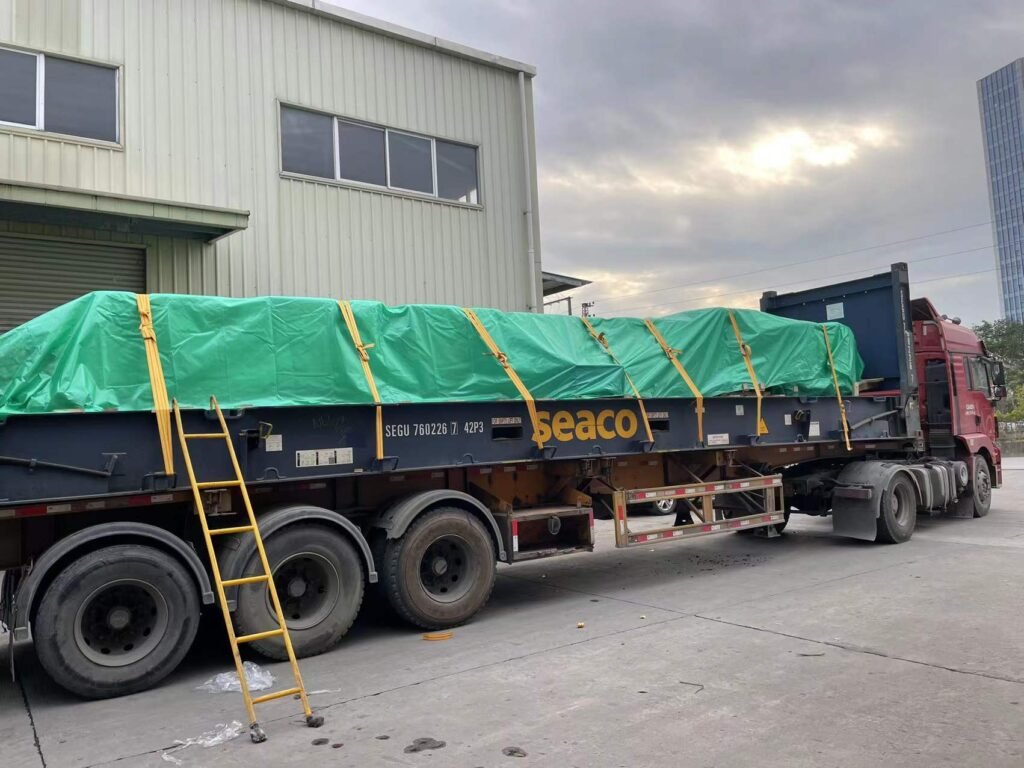
Why Large Injection Mold Transportation Is High Risk
Large injection molds are a very risky case of transportation situations due to the structural complexity and accuracy demands that increase the impact of a small accident. Some of them can reach tens of tons and multiple meters in length, size, and place a significant burden on the asymmetrical structures, which can lead to their tipping or deformation under the influence of irrelevant loads. Their alignment, parting surfaces, and internal parts ejector pins, cooling channels, and core inserts, are designed to tolerances as close as microns. Any transportation change will interfere with them, resulting in leaks, flash, or defective parts in the manufacturing process.
In addition to physical sensitivity, the risk is comorbid by environmental factors. Minor but irreversible changes (microcracks in steel or corrosion on polished surfaces) can be brought about by road vibrations, changes in temperature, and exposure to humidity. In my work experience with relocation of tooling to automotive OEMs, molds were made unusable not due to disastrous failures but through cumulative stresses that may only be discovered during recommissioning. This highlights the reason why the consideration of mold transport as a common logistics operation encourages avoidable production disruption. For a deeper look at the most frequent issues, see our guide on common risks in large mold transportation and proven prevention strategies.
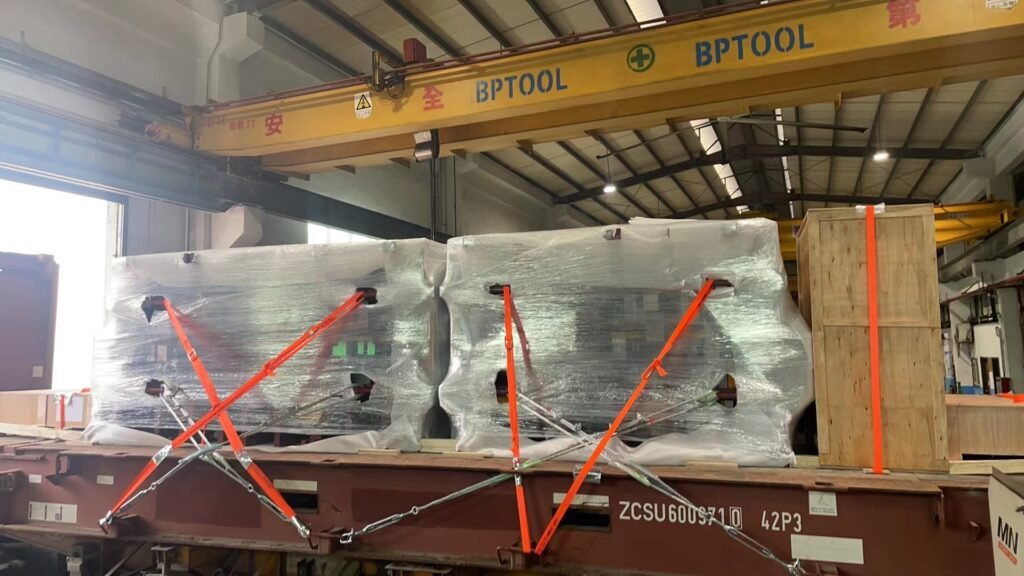
Key Risk Elements in Mold Design and Transport
- Weight Concentration: Molds having off-centered cores and asymmetrical cavity patterns have an unstable center of gravity which predisposes to occurrence of shifts in loads.
- Precision Sensitivity: Internal processes can never accept any variation; a 0.01mm error can bring the whole production line down.
- External Vulnerabilities: Surfaces and fittings that are exposed are prone to any kind of impact that heavy equipment may heave off.
The Difference Between Moving Molds and Moving Heavy Equipment
The transport of large injection molds is another thing compared to moving general heavy equipment since molds are useful precision equipment whose integrity must be on the micrometer level, and not structural longevity. Excavators or presses are heavy equipment that can be severely mistreated, i.e. bumped, tilted, or even slightly dented, without any harm to their main purpose. Molds, though, are dependent on perfectly finished surfaces, perfect alignments and closed interiors at which they generate quality parts with uniformity.
This difference is based on tolerance sensitivity: the line of parting of the moulds should be closed without leakage of material, and internal alignments should provide homogenization in cooling and ejection. When logistics teams lack the knowledge of tools, these needs are often underestimated, and a standard flatbed trailer or a generic way of securing the load is used, which works with machinery but not with molds. For instance, in large mold transportation services, the emphasis is no longer on sheer lifting power but regulated and vibration-damped movement.
Practically, it requires custom rigging by molds depending on engineering drawings, but heavy equipment may be provided with off-the-shelf slings. Ignorance of this may cause undetected damage such as distorted frames or misplaced inserts, which may not be detected unless in the molding press-this may cost a couple of weeks of lost time.
Practical Distinctions in Handling Protocols
- Tolerance Focus: In loading, sub-millimeter precision is required in Molds; heavy equipment can accept much wider margins.
- Surface Protection: Mold faces must be enclosed completely as opposed to equipment exteriors which may be open.
- Risk Assessment Level: Mold motions deal with finite element analysis of stress locations, and is far beyond basic weight checks of equipment.
Common Causes of Damage During Injection Mold Transportation
The most frequently encountered reasons of damage in large injection mold transportation are the lack of proper planning and implementation in which potential risks such as improper lifts or vibration are not properly addressed. The following is an organised summary on the main risk factors, their common causes and the damage that they cause- based on actual experiences in tooling logistics projects.
| Risk Factor | Typical Cause | Resulting Damage |
| Improper Lifting Points | None of these load analysis or engineering reviews. | Cracked frames, deformed molds or displaced internals. |
| Shock & Vibration | Ineffective route planning or decreased damping. | Dislocation, slacking fittings or steel microcracks. |
| Moisture Exposure | Poor packaging or covering. | Surface corrosion, rust in cooling lines, or wear. |
| Uncontrolled Securing | Lacking lashing or tie-downs. | Scratches or dents on the surface or movement of the load during transit. |
These can be complicating because such problems as vibration on a poorly secured mold may worsen the problem of ingressing moisture in case of the failure of the packaging. The only way to prevent them is to ensure preventive engineering input as opposed to reactive fixes.
Planning Requirements for Safe Mold Transportation
Safe large injection mold transportation can only be properly planned with an extensive evaluation of the mold as a high-value and fragile system instead of bulk cargo. This activity guarantees that all activities, such as measurement, to delivery will reduce perceived risks.
Step 1: Dimension, Weight, and Center-of-Gravity Assessment
Begin by obtaining accurate measurements on the size of the mold, the overall weight and center-of-gravity analysis using 3D scanning or engineering blueprints, because any minor imbalance can lead to tipping in the lifts. In center-of-gravity analysis in large mold transport, this step reveals hidden risks, and it is possible to design custom rigging that evenly allocates loads.
Step 2: Transport Method Selection
Select between overland trucking, sea freight or air depending on distance, urgency and sensitivity of moulds. In the case of large molds, lowboy or extendable flat trailers are necessary to keep the profiles low as well as minimize sway. Include permission to carry a heavy load to prevent having to use routes that are shorter.
Step 3: Route and Handling Feasibility
Determine road conditions, clearance of bridges and mathematical bottlenecks. Simulate manipulation at every point of transfer- crane lifts, warehouse staging, etc. to ensure that this is possible. Instruments such as route surveying software are used to foresee vibration hotspots.
Step 4: Protection and Packaging Strategy
The mold has vulnerabilities, which require a layered protection plan, which includes cradles, padding, and enclosures. This is incorporated with the overall logistics in order to carry out a smooth execution.
Protective Measures That Prevent Mold Damage
Large injection molds should be subjected to protective measures that address the threats to the environment and mechanical effects systematically because the brief exposure may interfere with the long-term performance.Anti-rust and moisture protection using vapor corrosion inhibitors (VCIs), coatings, moisture absorbers, and humidity gauges is key to protecting steel against oxidation and condensation during transit.
Waterproofing is also a key consideration; the inside of closed containers should have a moisture absorber and humidity gauge to inhibit condensation that may pits or give rise to fungi in the channels. In the case of international transfers, anti-rust and moisture protection for exporting large industrial molds presents guidelines such as vacuum sealing that forms a vacuum covering against changes in humidity.
Reinforced crating reinforcers consist of timber or composite construction frames with foam inserts to fix the mould, and shock absorbing tools use air-ride suspensions and damping pads to insulate the vibrations. These are tested in the form of mock loads in the execution so as to check their effectiveness, so that the mold is reachable in production state.
Essential Protective Techniques
- Vacuum Sealing: Eliminates air and helps to avoid moisture infiltration, which is perfect in international deliveries.
- Reinforced Crating: Built in custom-made where load bearing points are placed so as not to damage the contact point.
- Shock Damping: Impact absorbing Layered products such as rubber cushions to absorb the shock caused by road irregularities.
Managing Shock, Vibration, and Long-Distance Transport Risk
The distance of long-haul transportation of massive injection molds increases the risk of vibration and shock, as the stress accumulates over long distances and can deteriorate precision components.
In vibration, specifically, the vibration goes through the structure of the mold, where the bolts are loosened or the welds are fatigued unless they are damped.
In order to control this, use real time monitoring devices with accelerometers which record the G-forces and give alerts on threshold. In vibration and shock during mold transportation, data demonstrates that the peak vibrations can be cut down by up to 70% when controlled speeds and air-suspended trailers are used when maintaining alignment.
Monitoring is more important than rushing due to the fact that problems are detected early enough-much better than repairing after they have been delivered. In the case of transcontinental movements, the additional control layers of waypoint inspections are available.
Strategies for Risk Mitigation
- Vibration Damping Systems: Built in trailers to allow only the bad frequencies to pass which are detrimental to molds.
- Real-Time Monitoring: Sensors give information on which adjustments can be made.
- Route-Specific Planning: Designed to reduce cumulative exposure.
How Improper Mold Transport Impacts Production and Cost
Lack of proper transportation of big injection molds translates directly to disruption of production and increased costs since due to the damage, it is likely to need a lot of re-alignment or repair which would slow down commissioning. Downtime may take days to weeks, putting the lines with high output such as automotive parts production on hold.
As an illustration, improperly aligned parting line can require on-site machining which will involve labor and tool costs. Recommissioning is done through trial runs that check fixings which pose risk of scrap due to flawed components. In a real-world large mold transportation project, cost-cutting in other areas has resulted in costs many times larger than the original transportation savings — sometimes by 10 to 1. See our large mold transport case study to understand how proper planning avoids these outcomes.
Lost revenue through stalled presses and reputational losses in delayed deliveries is an example of hidden costs. Obvious costs on low-cost logistics are in the shade of these, and the importance of engineering rigor is justified.
Quantifying the Impacts
- Downtime Costs: Hours down times are multiplied by the hourly value of production.
- Repair Costs: Between the repairs and complete renovations.
- Opportunity losses: Late entry into the market, or contract fines.
Conclusion — Safe Mold Transport Is an Engineering Decision
Production-critical resources are large injection molds. Their transportation cannot be safely implemented without the same engineering judgment that was used in the design and production of molds- not logistical short cuts. The manufacturers can escape the traps of destruction and unproductivity by focusing on prevention by planning, assessing risks and executing protective measures. This science makes sure that there is a smooth movement of molds throughout the facilities without compromising their accuracy and consistency to continue their operations. Finally, considering transport as an extension of the engineering process protects the asset and bottom line. Partnering with specialists in industrial machinery and manufacturing logistics ensures your high-value molds arrive ready for immediate production.